30
Nov to 29 Dec Hungary for a change
 c1812 5Dec04
 |
Route:
Redics – Lenti – Varfolde – Zalakaros – marcali – Somogygeszti
– Varong – Szakaly – Felsonana – Fadd – Hajos – Kisszallas –
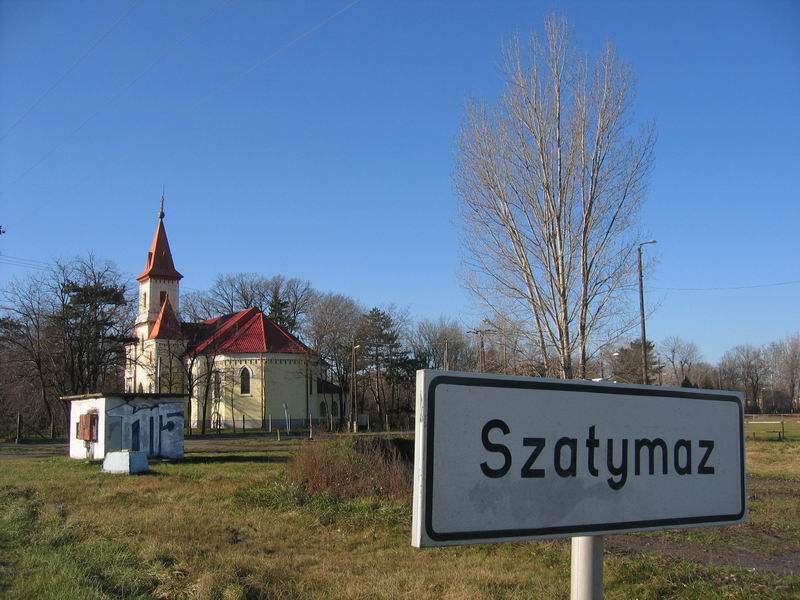
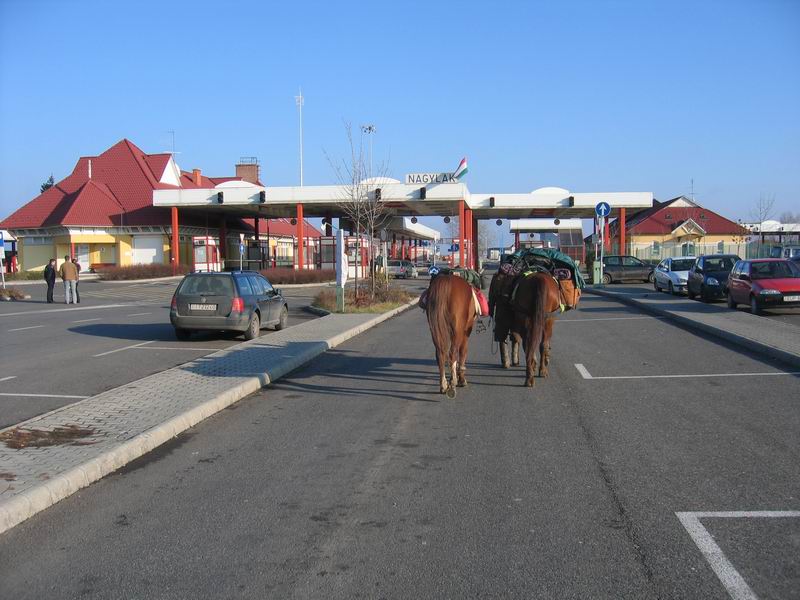
Pustamerges – Bordany – Szatymaz – Algyo – Mako – Nagylak.
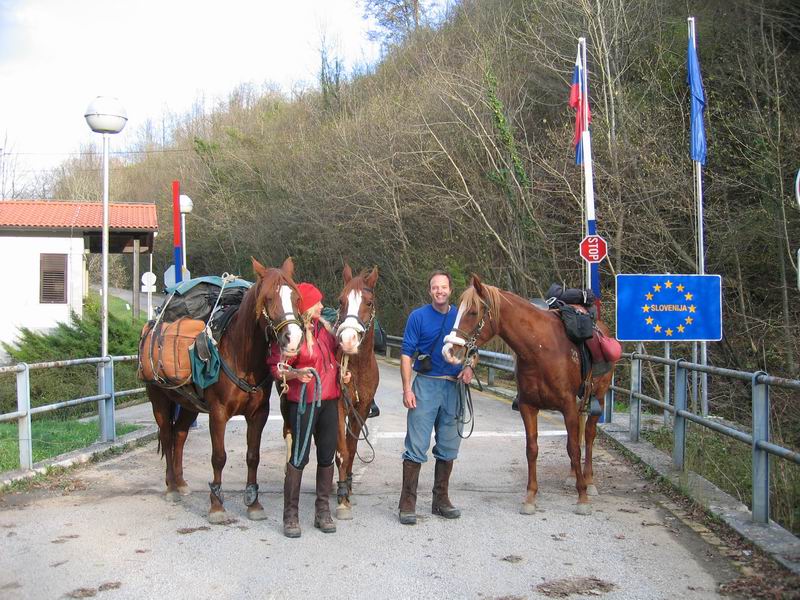
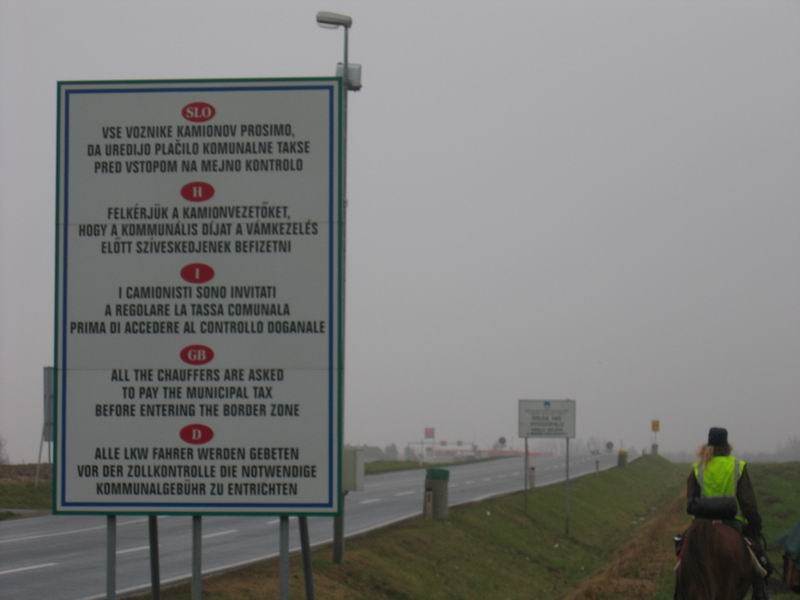
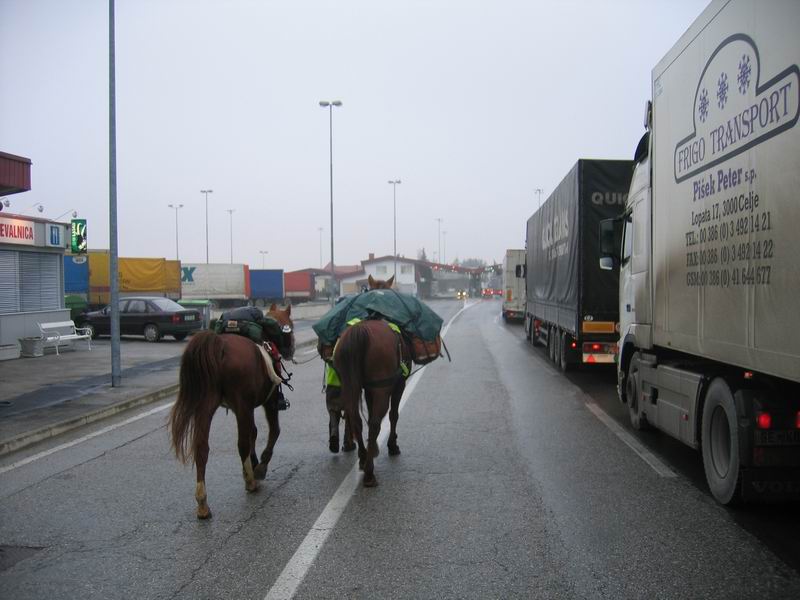
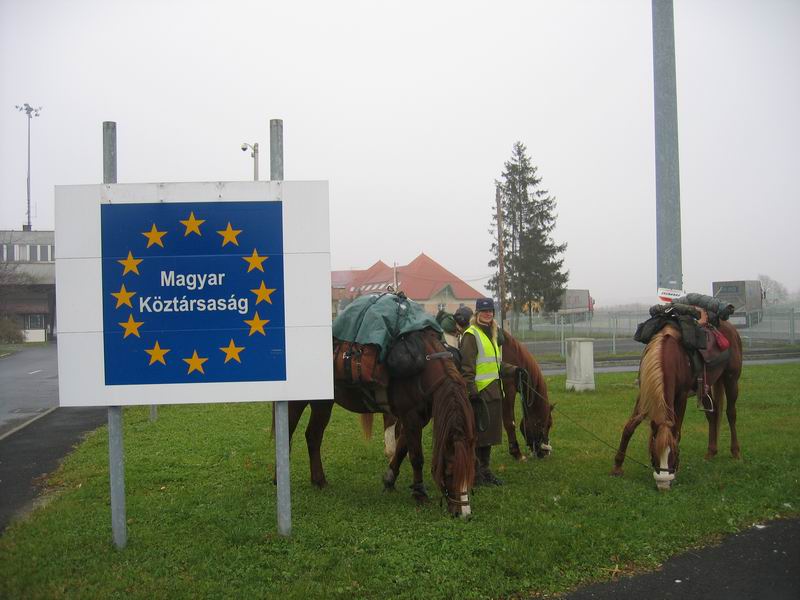
The Hungarian border guard
clearly missed the good old days of rules and restrictions.
He spent an age going through the horses’ passports but finally waved
us through; We’d ridden
from the land of the Celts to the home of the Magyars with no border nightmares.
Maybe it was just the drizzle
but everyone in the first town, Lenti, looked depressed.
Our smiles were not returned – what a contrast from Slovenia.
We tried saying “Cheer up Bran !” in a Cockney accent and sang
“Always look on the bright side of life”, but it didn’t seem to work. The people of Lenti (the Lentils perhaps ?) just were
not happy beans.
Over the next few weeks we not
only met a lot of warm, kind Hungarians, we also began to understand a little
about rural life in this part of the world. The changes brought about by membership of the EU have
had a catastrophic effect on farming and the rural communities.
With one in five people unemployed in some areas it is not surprising
that not everyone’s smiling. Many
people we spoke to, said things had been better in communist days;
“At least everybody had work, there
was job security. “ “But
you must have more freedom now ?”
I suggested to Jutka. “Of
course” she replied
“but I can’t afford to do anything with it” .
When we heard people blaming
the big supermarkets, “like Tesco”
for driving down prices paid to farmers,
it was a case of “deja-vu” all over again – we’d been hearing the
same story all the way from home. We’d
been surprised to see Tesco’s carrier bags littering road verges in Hungary
– The men in suits must have decided there were profits up for grabs in this
new EU State.
Fortunately for us, rural
decline was not yet complete, villages
were still served by shops, busses and telephone boxes.
We noticed other small differences in Hungary.
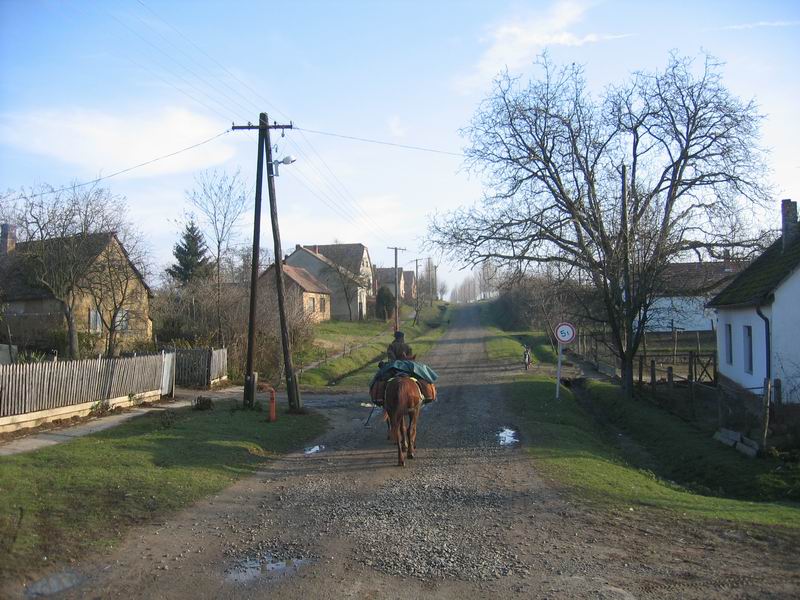
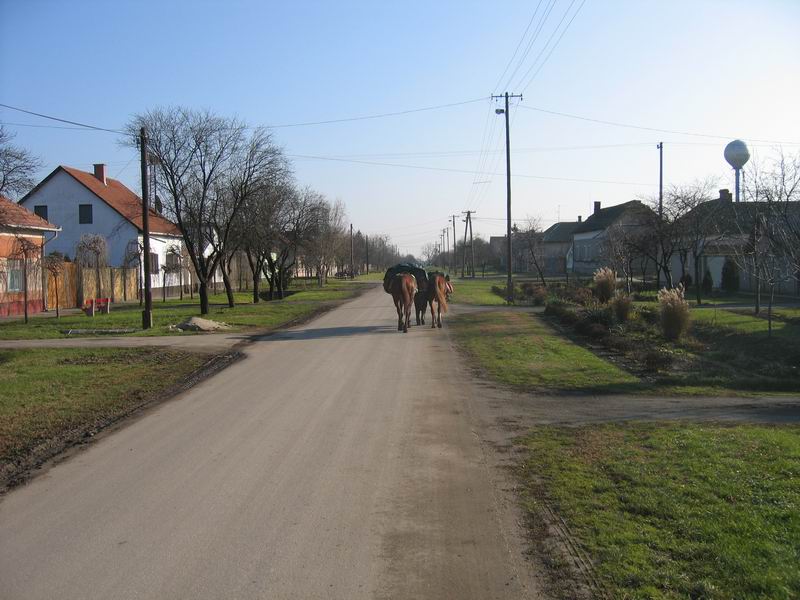
Many of the roads were wide with huge verges and separate paths for
cyclists and pedestrians, and the
houses seemed to be built sideways on to the street – they don’t have front
doors. After a long cold day in the saddle, it was great to be
invited indoors where we could warm up by the beautiful ceramic tiled
fireplaces. We’d seen one
or two of these in Slovenia but they were commonplace here.
They save the heat that normally disappears up the chimney by using flue
piping to heat up tiles.
Talking of differentness,
the Hungarian language is a good long way up the scale of differentness. It’s nearest relative is Finnish, but even a Fin wouldn’t have a clue what a Magyar was on
about. Apparently, around
2000 BC, some adventurous types from East of the Urals set off on a big ride of
their own. The group
headed West, but somewhere along the line had an argument (probably about
who’s fault it was when the horses ran away)
and split up; some
went North to Finland while the rest came South to Hungary.
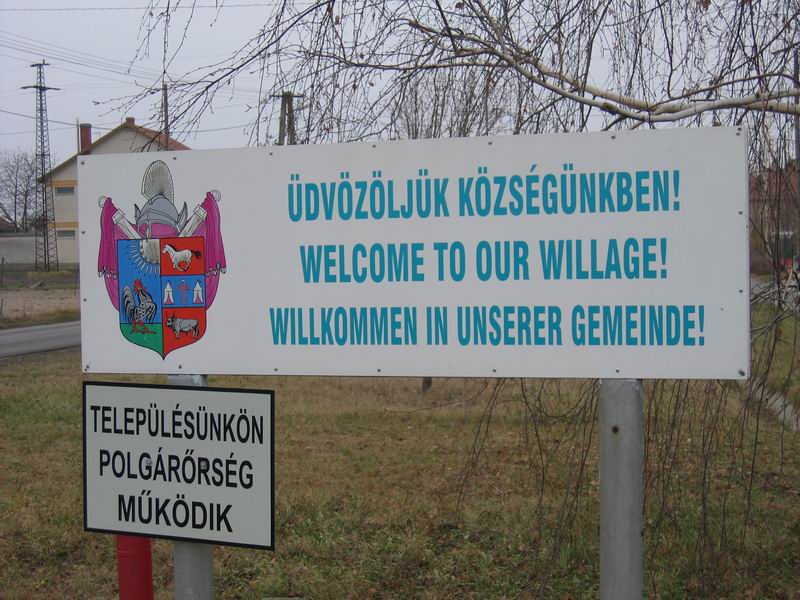
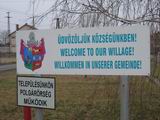
This might explain why, when we saw the sign
“udvozoljuk kozsegunkben !” we didn’t know whether to be pleased or
run screaming. Fortunately in
one place, it had been translated underneath
“Welcome to our Willage !”.
Our Hungarian was basic to say
the least, and there were far fewer English speakers about than in Slovenia.
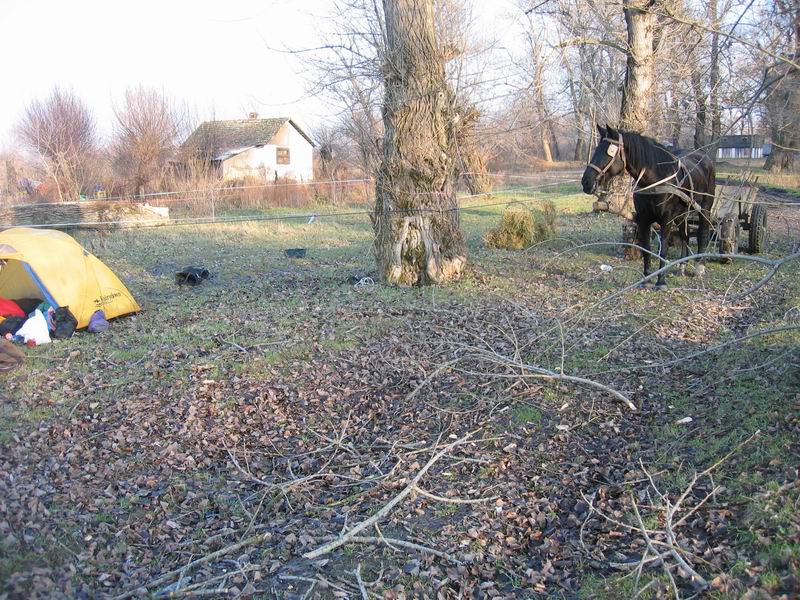
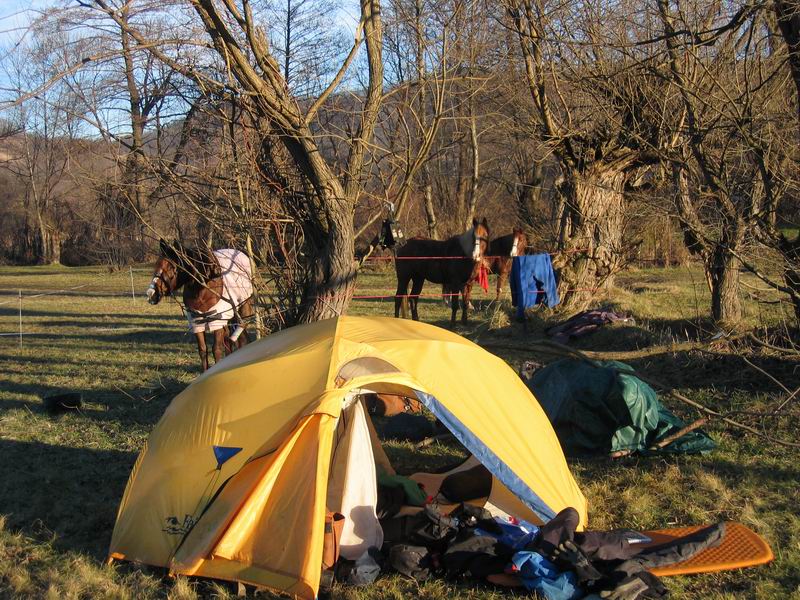
One night we stopped at a farm and, in a mixture of Hungarian and sign
language, just about managed to establish that we could stay and use our
electric fence to make a pen for the horses in a corner of the field.
Later in the evening, a man who spoke some English came over to the tent.
He seemed concerned about something.
“The boss lives 10 to 15 metres away to the North “ he said.
We were standing at least 50 metres from the nearest building.
“Ah 10 to 15 kilometres away ?” I suggested. “No” he replied firmly
“!0 to 15 Meters !”. After
convincing himself we were “turistak” – tourists, he left us alone to
ponder on the mystery boss and his amazing invisible house.
In Zalakaros we stopped for a
rest day. It’s a thermal
spa town just South of Lake Balaton, and seemed like a good place to clean up a
bit since our last shower somewhere back in Slovenia. All I really wanted was some hot water,
but the only place I could find seemed to be more like a hospital,
complete with shot-putter type women in white coats and German geriatrics in
bath robes. I read down the
long list of treatments on offer. Half way down was “Magnetic Ring” I may have been a bit saddle sore but no way was I ready for
that one. Instead I settled
for a dip in the healing waters and immediately felt young – everyone else in
the pool was a least 75. After
about half an hour at 40 degrees C I was as nearly as crinkly as the rest of
them, so I had to get out and return to the tent and the chill of a Hungarian
December.
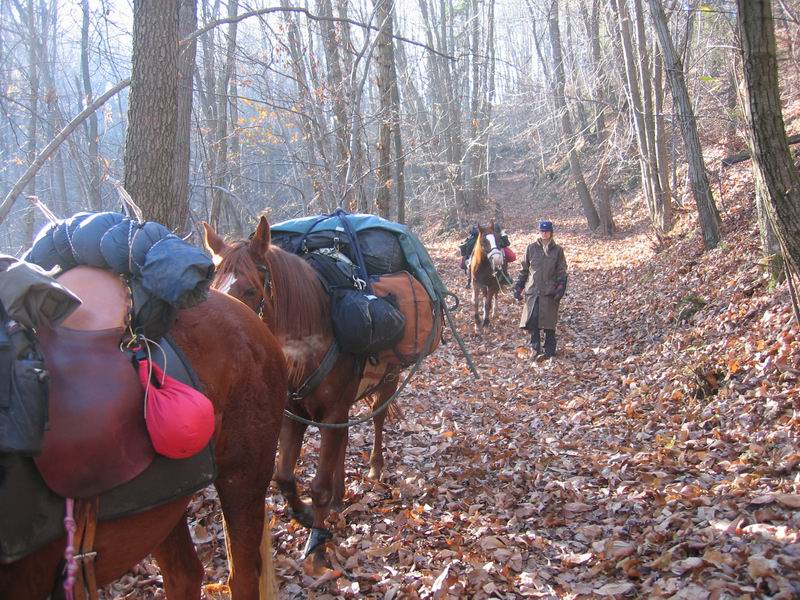
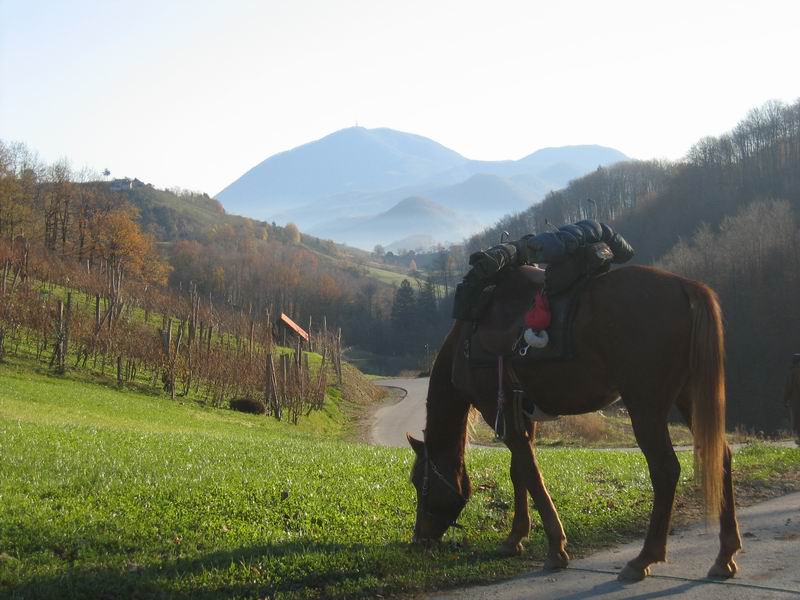
Hungary was designed for
horses and we found some great riding.
Long tracks between villages kept us off the roads but even the roads
were quiet. Some tracks were
muddy with deep tractor ruts. Sometimes
we slid around on a thin surface with frozen ground beneath,
but often we had good sandy going through miles and miles of forest.
There were deer everywhere and birds again.
In France and Italy, the big tough hunter had blasted all the birds from
the sky; we hadn’t heard a
decent dawn chorus since Devon.
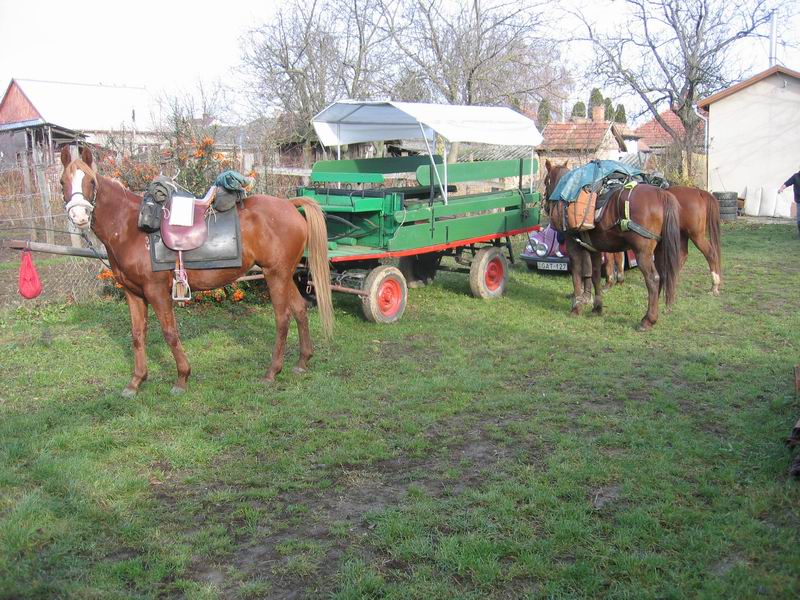
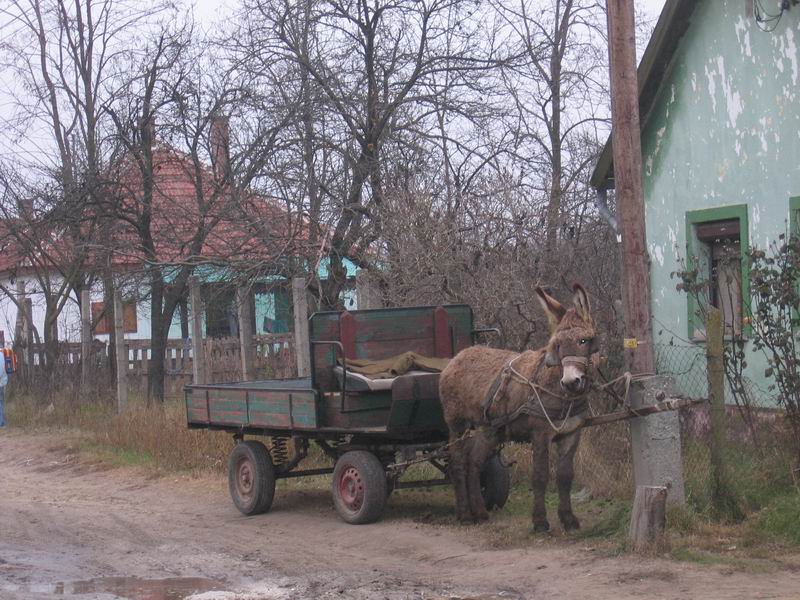
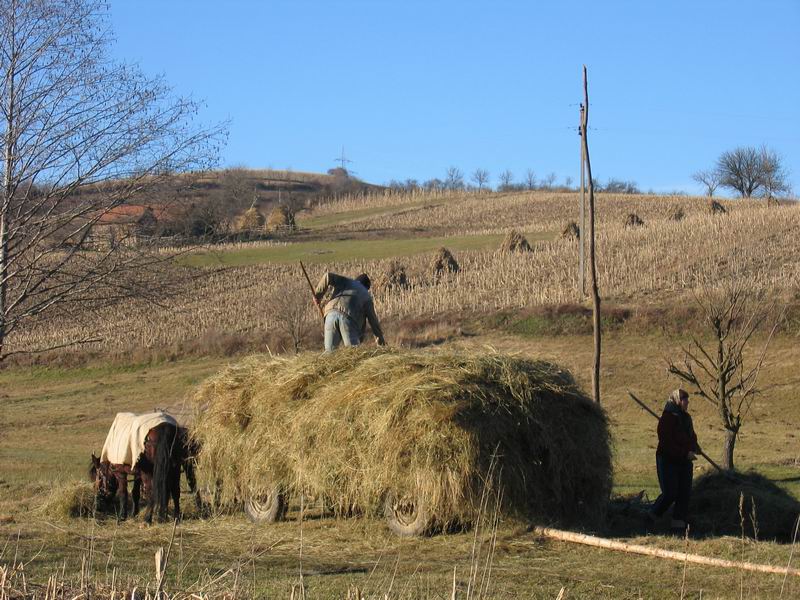
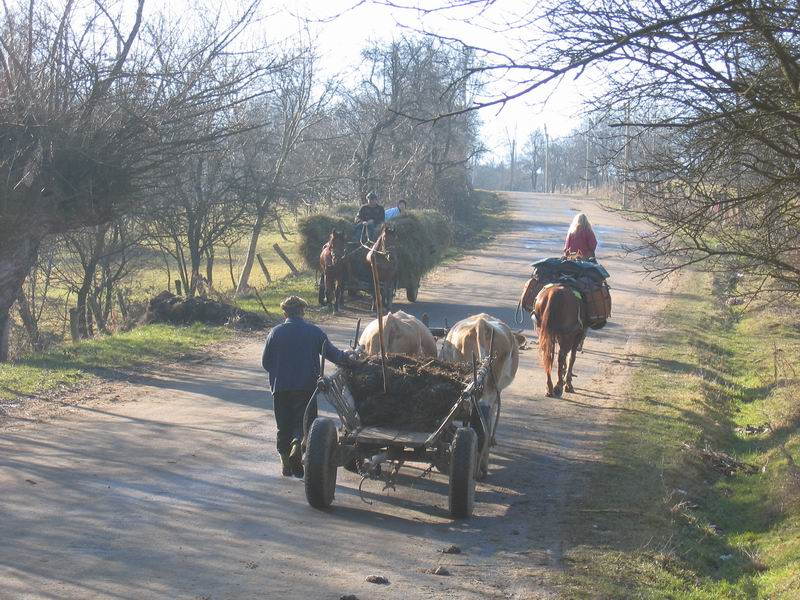
On a long “foldut” (field
road) through a vineyard village near Marcali we came across the first working
horses of the trip. I am
afraid to say that I ruined Lisa’s experience of this moment by claiming that
they were tourists. After
seeing a second cart shortly afterwards, I was forced to pretend that I had seen
a web site advertising “Authentic Hungarian Carting Holidays “. After the third, Lisa asked me whether the company on
the website provided the loads of timber / corn / hay / manure / etc as part of
the package or were they an add on extra ?
I was forced to back down and admit defeat.
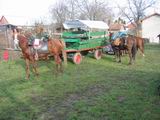
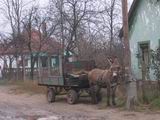
Driving one such cart was
Peter the horseman. While
his horses waited, nicely rugged up to keep them warm, he was collecting corn
cobs that the combine harvester had missed.
As soon as he saw us, he jumped on the cart and drove over to talk.
He was delighted to hear where we’d come from and led us to a place
where we could stop for the night – an old collective farm owned by a friend
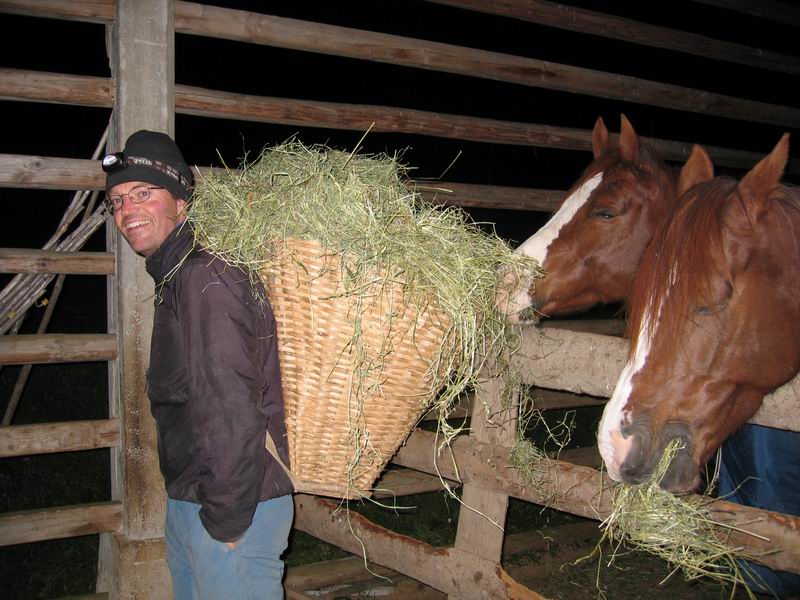
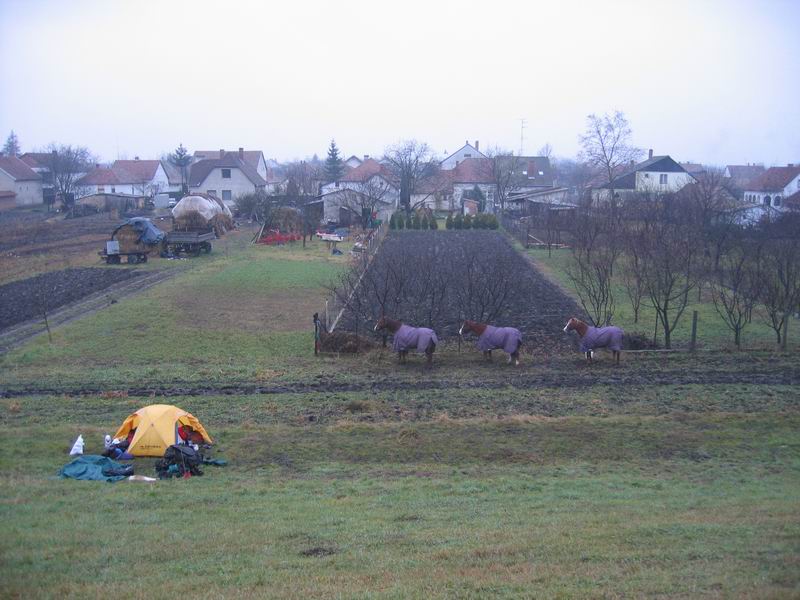
of his. We built a pen for
the horses in the yard and hay, oats and water were soon in place.
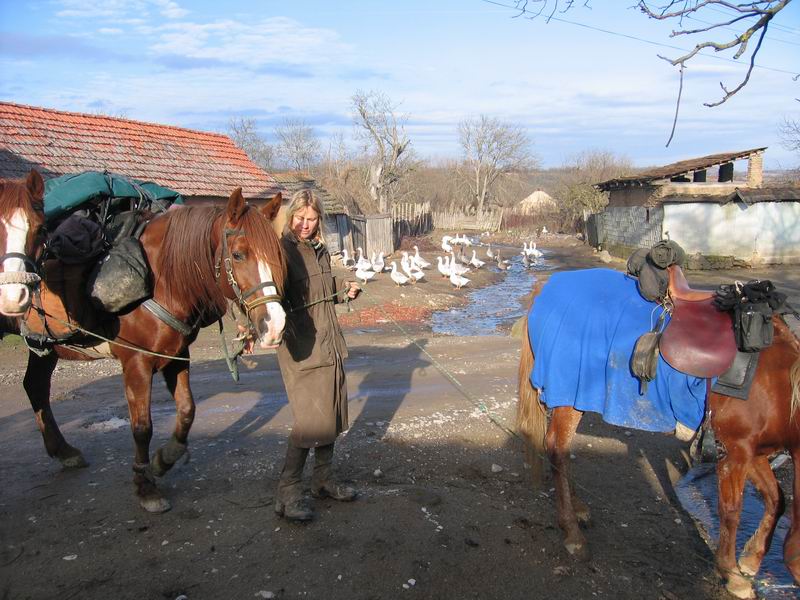
There were pigs, horses, chickens, goats and dogs roaming about the yard
– a real Old MacDonald job
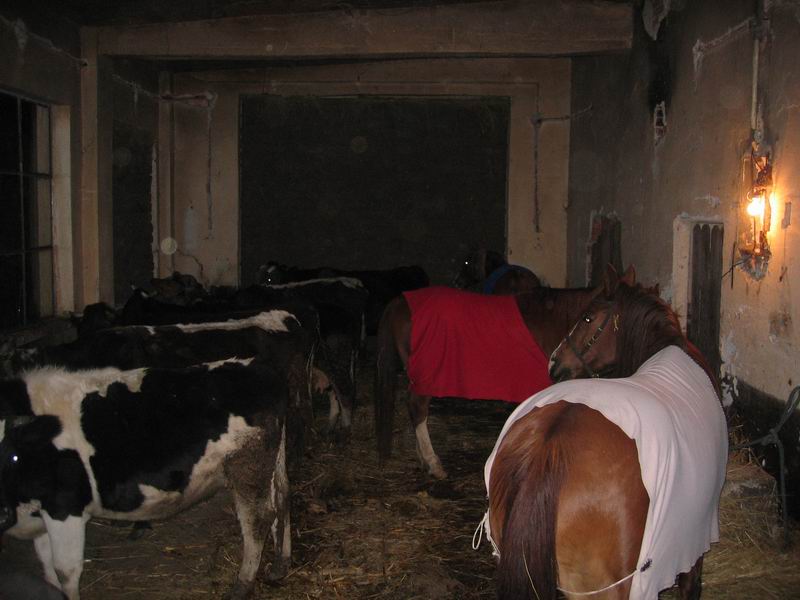
But it wasn’t a great night for sleeping – one of the farms horses
broke his head collar, broke out of the barn and came over for a chat with the
visiting horses from Wales. Five times between midnight and six am we had to
get up and chase him away, much to the disgust of Hannah who was being all
girlie and flirty thinking this hairy clodhopper was a bit of a stud – he
wasn’t !
Still, this was more than made
up for by the kindness showed to us by Peter and his wife.
We didn’t feel happy leaving the horses so we reluctantly turned down
their offer of a meal. But an hour later they were back with a big pan of
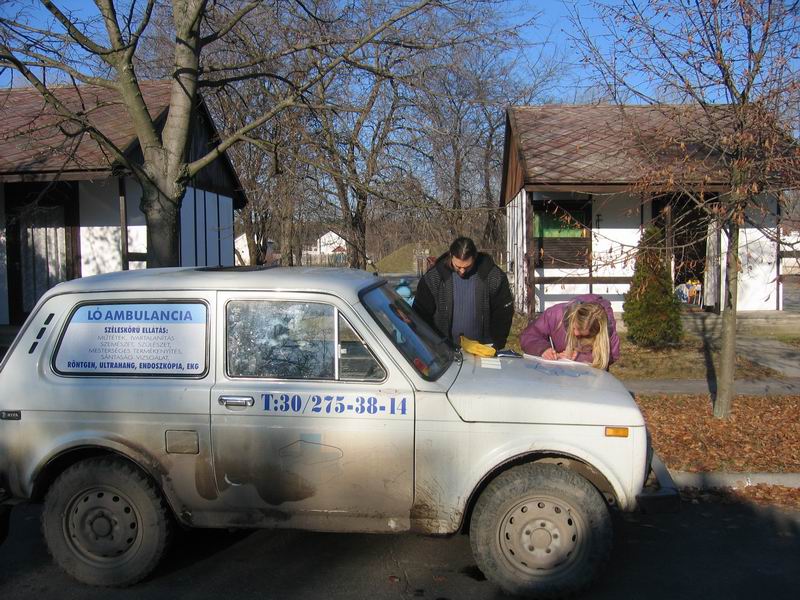
goulash and bottles of wine. We
ate in the dark off the bonnet of their Trabant while they asked us about the
trip. The next morning Peter
showed us photos of his visits to Germany to demonstrate Hungarian horse skills
eg. Horse lying down,
sitting like a dog while Peter used the forelegs as a backrest etc.
He was a true horseman, the beneficiary of centuries worth of knowledge
passed down through the generations.
His enthusiasm was infectious, matched only by his generosity:
he wouldn’t let us leave without a souvenir – a beautiful handmade
leather driving whip which he coiled up and placed over Lisa’s head like a
medal.
Another encounter and another
Peter. It was mid morning.
A mud splattered pickup overtook us but this one skidded to a halt in
front of us and out jumped Peter the Vet.
He was an Arab enthusiast himself, and the sight of our gang had brought
on his emergency stop. “Where
are you going ? “ he asked. “To
Syria and Jordan” we replied “We’re talking these three back to their
roots.” He laughed, gave a
bow, and insisted we go to his house for a drink.
Two glasses of ‘Palinka’ (52% proof plum brandy fire water) later we
attempted to carry on where we had left off,
ie riding vaguely Eastwards across Hungary,
but it wasn’t easy. The
glasses had been big and the palinka lethal.
Luckily three out of the five of us were sober and Audin pressed on
regardless while Lisa sprawled over his neck telling him how much she loved him.
We’d had an interesting chat
with Peter- in a bizarre mixture of
Hungarian, German and French usually all three in one sentence – and he’d
offered to take us to visit the Hungarian National Stud at Basolna the next day.
True to his word, the following morning, he turned up in his pickup.
While one of us heroically stayed behind to see to the horses every need
in the sub zero temperatures, one
very lucky girl was whisked away on a day trip.
Lisa writes:
The previous day, before my mind became clouded by alcohol,
Peter had shared with us some of his knowledge of Arab breeding in
Hungary. He owns
several “Shagya Arabs”. This
is a specifically Hungarian breed of Arab blood, but having being selected over
many years for strength and robust conformation, these are lovely animals strong
and useful but with the unmistakable quality typical of Arab blood. I will always be grateful to Peter
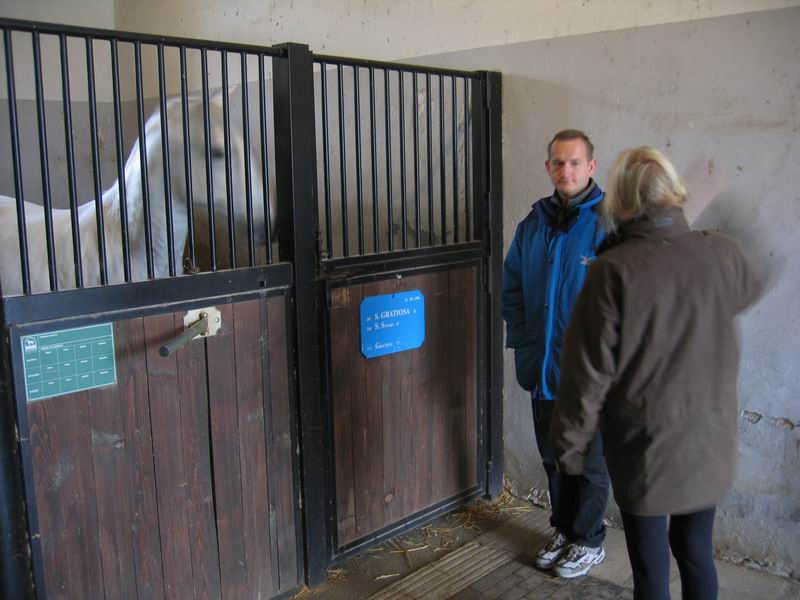
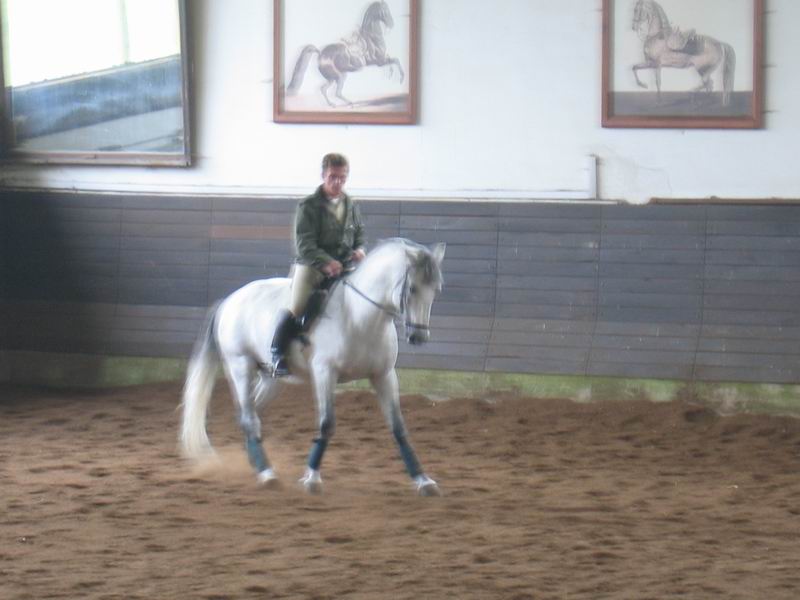
for driving me the next day the long way to Babolna which is the National Stud
for pure bred, as opposed to Shagya Arabs – although confusingly there is a
pure bred line called Shagya named for the foundation stallion.
Peter had been stud vet at Babolna for many years and thus was able to
show me around the central courtyard surrounded by stallion barns, the mares at
pasture and a short drive away the young stock holding.
There was quite a variety
of type, some older stallions particularly were very beautiful, deep bodied with
good bone and short cannons. (I
am not an admirer of the over extreme weedy Arab that some people breed to meet
the limited demands of the show ring. )
The highlight of the day
was a coach ride arranged for me by Peter around the beautiful arboretum, the
coach drawn by five lovely grey Arab mares in the Hungarian “koch 5”
arrangement of three in the front row with two behind them.
Thus viewed from the coach each horse can be seen as they are ranged in a
fan shape. The sheer beauty
and floating action of these fine mares made this excursion a magical experience
for me. Before
returning to the stud we visited the graveyard where treasured horses were
buried, each with an intricate carved headstone.
On the way home I was
brought down to earth by Peter’s description of the precipitous decline of
agriculture in Hungary – we passed at least seven huge dairy farms, each now
empty and abandoned. Peter
felt that for rural Hungary, joining the EU had been a “catastrophe” –
from what I saw I would say he was right.
The short December days caught
us out on a few occasions. We’d
passed through one village and it would feel like early afternoon,
too early to start asking around.
But by the time we’d reached the next it would be starting to get dark.
We couldn’t just flash the headlight switch and carry on, we had to
find hay, oats and water as soon as possible.
On our last night West of the
Danube, we’d carried on too long
and found ourselves in the town of Fadd just as it was getting dark.
Our enquiries drew blanks. We
had no choice but to carry on out of town.
On the edge of town we saw the, by now familiar, long low white buildings
of a former state collective farm, but there was something strange about this
one,. It had been turned into a factory of some sort and
there were lorries coming and going.
In desperation we marched in, up to the first lorry driver and said
“szeno ? (hay) “.
Miraculously he led us round the corner and pointed to a barn full of
hay. It wasn’t his but it
was pitch dark, we’d found food, the decision was made for us, we were
stopping. The lorry
driver drove off and left us on our own.
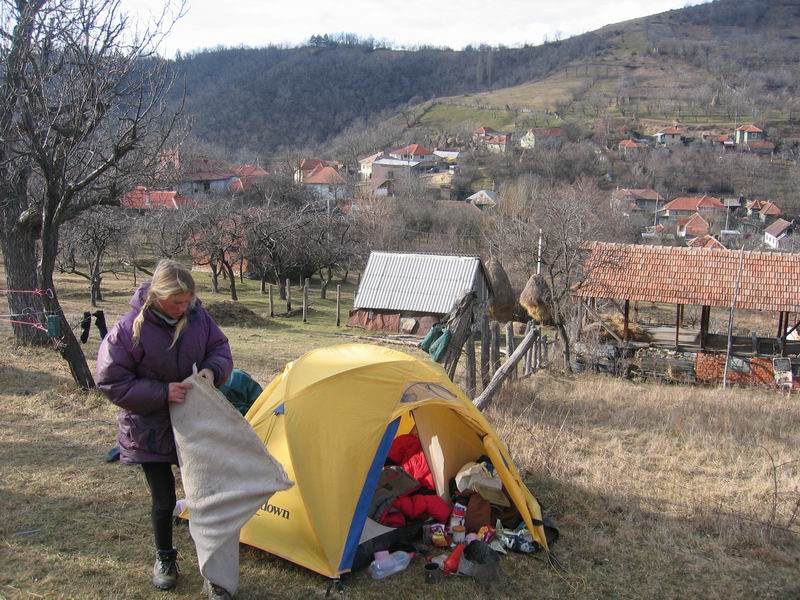
There was nobody around to ask about the hay, so we unloaded the horses,
made a pen in some trees behind the barn and pitched the tent.
Just then a security guard
arrived with a snarling Alsatian tearing at his lead. We couldn’t stay.
He’d asked his boss and it wasn’t allowed,.
He had to let the guard dog loose.
We had no option but to beg.
Whatever he said next was very likely to be Hungarian for “Oh, go on
then, just this once”. There
was just one condition; We
had to be gone by 5am. That
meant a 3.30 am alarm. Grim,
but that would be tomorrow’s problem.
Today we were all right. The
guard suddenly became our best mate – water, hay and a bucket of corn all
appeared out of the darkness.
For two hours the next morning
we walked along the road in the dark, desperately
willing the first streaks of dawn light to appear on the horizon.
They arrived just as we reached the Danube at Dombori and just in time
for us to see that there was no ferry.
So why was there a little ferry symbol on the map, and why had people
told us we could cross there ? “It
only runs in Summer” was the
answer. There was a ferry running but it was 5 miles up river
towards Budapest. Fortunately
for us it was 5 miles of grassy flood bank and a perfect canter all the way.
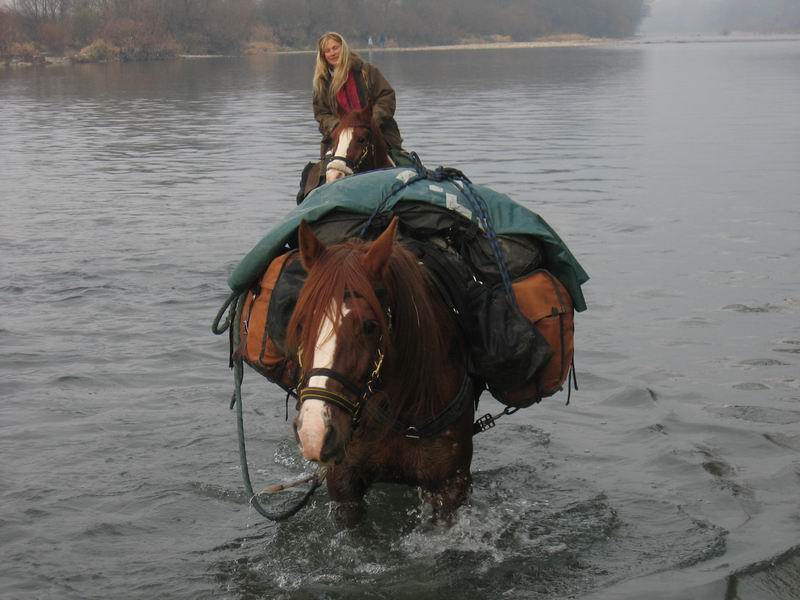
Our companions were well behaved as they followed the cars onto the small
raft and enjoyed the view as a tug boat pushed us across the famous river.
Once landed on the other side
it was another 5 mile canter back in the Belgrade direction to reach the village
we’d seen across the river at first light.
We were now on the Hungarian plane and it was Great but we still had a
long way to go to reach our target that night, the town of Hajos where we had
the address of a horse place. We
arrived at dusk, after nearly 60 kilometres, to find the place deserted except
for three horses. Our own
three had been heroic but we weren’t in the
mood for messing them about any longer;
there were horses so there must be horse food, so we were staying. To our relief, a man turned up at feeding time
and let us in. It turned out
that the place had closed down two years previously.
Tourists never came and the Dutch owner had pulled the plug.
We were to find quite a few others in the same state before we left
Hungary.
After miles of ploughed
fields, we had finally reached the proper grasslands of the steppe or the
“Puszta” – real horse country.
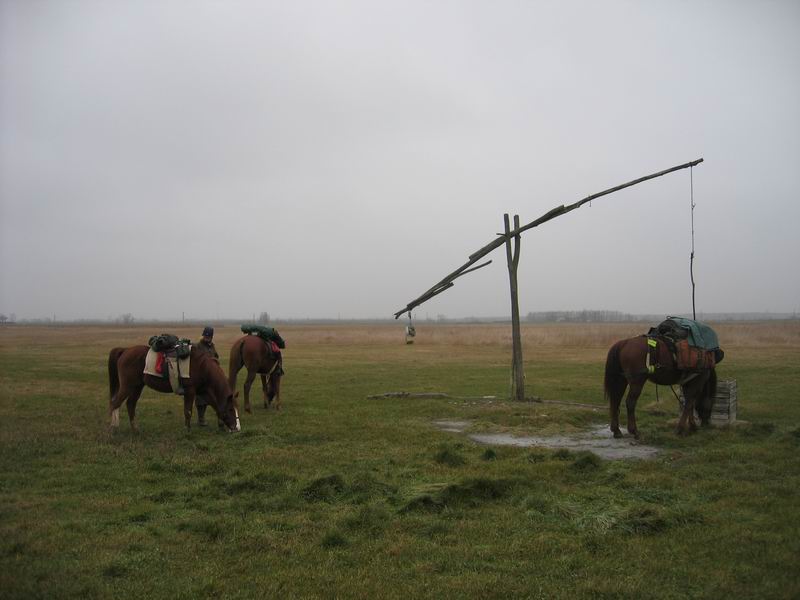
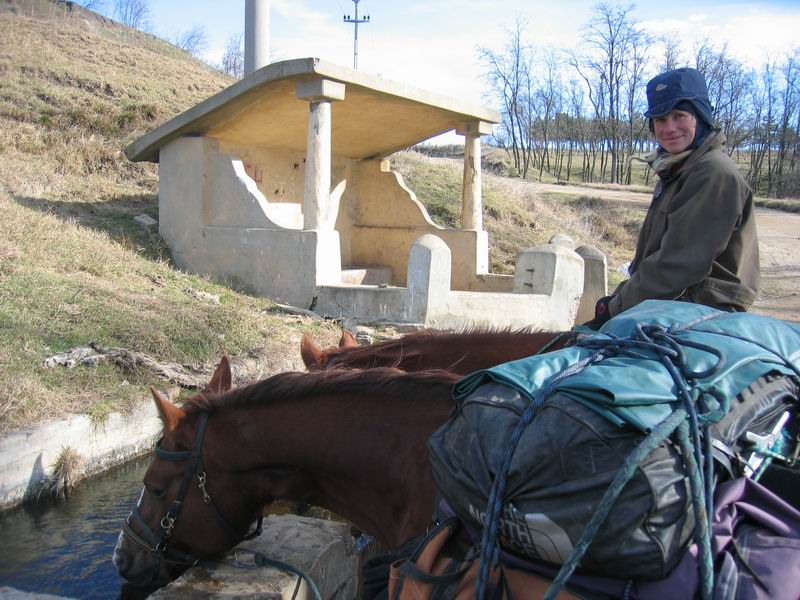
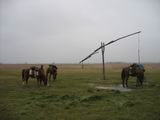
We stopped at one of the old cantilever wells.
A forked upright supports a long wooden pole arm with a rope and bucket
at the well end and just the right amount of counterweight at the other.
These must be a welcome sight to passing horses in the heat of summer.
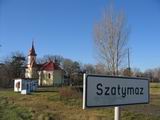
On our last night before
reaching Szatymaz our Christmas break destination, we had another remarkable
encounter – The kind that’s hard to imagine happening with any other form of
travel. We were in the
village of Bordany, it was getting
late and we needed help. A
small crowd gathered round the five of us where we had stopped at the village
shop to ask if they knew of a place where we could stay.
We weren’t getting very far, things didn’t look promising. But then Eva turned up and said “Follow me”.
It was a couple of miles to
her house and Sealeah, who has yet to decide whether to use her powers for good
or evil, actually did a good deed – she carried Eva’s shopping bag for her
all the way home. Eva
didn’t have any hay, but there was a small patch of lucerne behind the house.
We put up the electric pen and Eva brought cobs of corn.
No sooner had we pitched the tent than she came over with a bottle of
freshly drawn off wine and a big jar of peaches.
Inside the tiny house, there
were two rooms; a kitchen
with just enough space to squeeze round the small table and a bedroom that was
all bed and no room. Eva was
worried that the horses water would freeze over and that she wouldn’t be there
to bring water in the morning. “You
must knock on the door” she said
“and ask for more”. She
told me she left at 3:30 every morning to walk two miles to Bordany and catch
the bus to the city to do her ironing job.
For this she earned about one Euro per hour.
Her daughter had grown up and left home, but she still supported her 11
year old son, who told me he was
going to be a rally driver. In
the morning, we left a Christmas card and some money.
All across Hungary people had put us up and fed us and all had refused
any payment. Eva would have
refused as well, but we didn’t give her the chance.
It was the least we could do; in
our hour of need she had said “follow me”.
The abiding memory of our
Christmas stop at Szatymaz is that of fish soup. Each time we visited our neighbour, Hodi Karoly and
Bea, there were several fish
swimming around in one half of the large double sink in their kitchen. In the corner, a huge cauldron hung on a chain
over a gas burner and out of this cauldron came the local Szeged speciality:
fish soup. We were
presented with huge bowls of the stuff from the never ending supply.
We tried to work out the best time to visit, but there was no escape, the
fish soup was always there. But
this was a small price to pay; the
Hodis very generously gave us all the hay and oats our horses could eat during
the 11 day stop and Bea ferried us into Szeged
to stock up with essential Christmas supplies.
Our last few days on the great
Hungarian plain were again marked by people’s generosity.
At Algyo we camped on a river bank behind a long row of houses.
In the space of a few hours, four different neighbours had come over for
a chat and all brought us food and drink of some kind.
Our mountain of donations included; three bowls of soup (they’d seen
three horses and assumed there’d be three humans) ,
bread, cheese, sausages, roast potatoes, apples, one flask of coffee, two
flasks of tea, a bottle of red wine and of course, the inevitable plastic bottle
filled with palinka. Hungry
in Hungary ? No chance !
Koszonom Sepan to:
-
Culup Csasa in Zalakaros
-
Marianna and Katalin in
Marcali Baronka
-
Dr Balazs Peter in Raksi
-
Govnik Peter in Szakaly
-
Astalos Istvan and Jutka
in Felsonana
-
Stafan Laszto and
Gabriella in Hajos
-
Bundala Melinda
inKisszallas
-
Gea
Vilmos and Judit in Pustamerges
-
Eva and son in Bordany
-
Hodi Karoli and Nea in
Szatymaz
-
Everyone in Algyo
-
Kavocs Peter and Andrea in
Mako
|
 c1814 6Dec04
 |
 c1815 6Dec04
 |
 c1820 9Dec04
 |
 c1830 11Dec04
 |
 c1838 11Dec04
 |
 c1852 13Dec04
 |
 c1854 14Dec04
 |
 c1857 15Dec04
 |
 c1890 19Dec04
 |
 c1895 19Dec04
 |
 c1899 19Dec04
 |
 c1900 19Dec04
 |
 c1904 19Dec04
 |
 c1807 21Dec04
 |
 c1915 25Dec04
 |
 c1923 29Dec04
 |
 c1927 30Dec04
 |
30
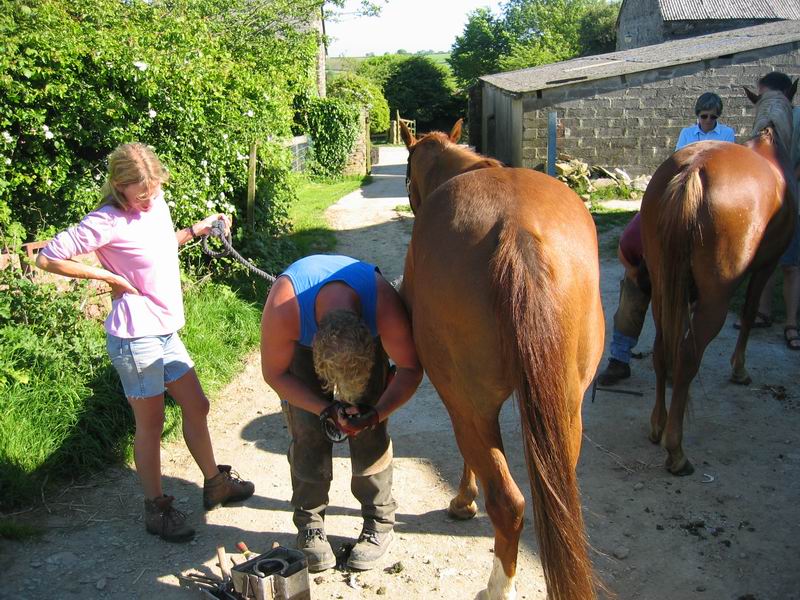
Dec 2004 – 27 Jan 2005 Romania
– Life in the Freezer
 c1936 30Dec04
 |
Based
on a comprehensive study, using a carefully selected sample of two locations,
I’ve reached the conclusion that the amount of litter on road verges increases
exponentially as an international frontier is approached.
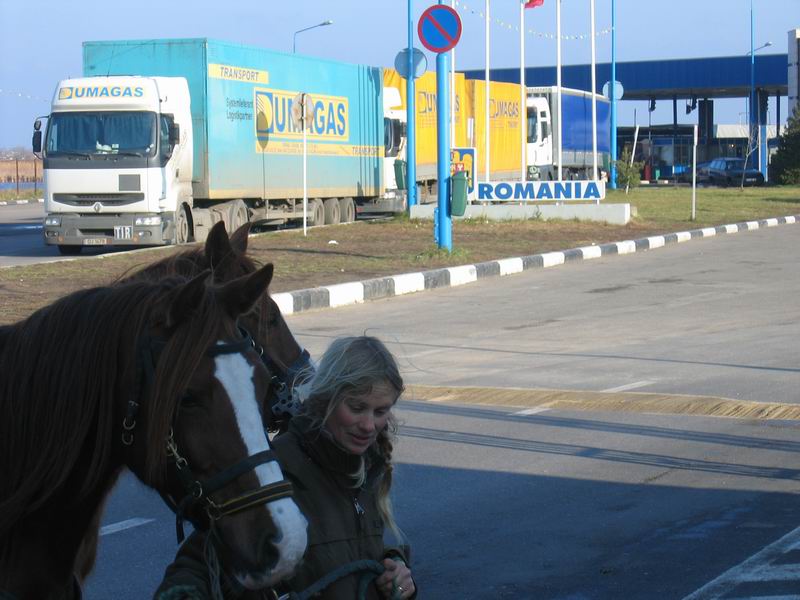
On the final few hundred metres to the Hungary/Romania border at Naglak, the broken glass beside the road became so bad we had to ride
down the “Tir” lane with the 40 tonne trucks, it was the lesser of the two
evils.
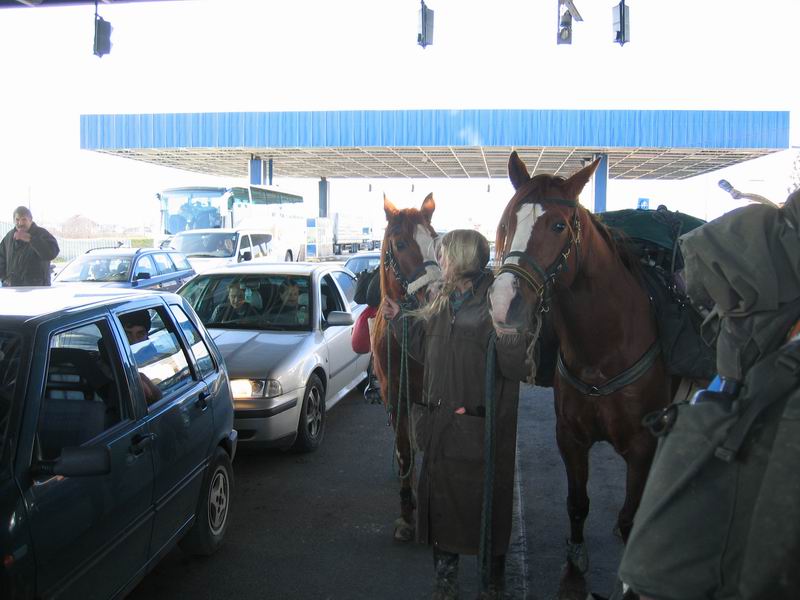
At
the check point we were waved straight through;
We couldn’t believe it, all the effort we’d gone top to get the
health certificates. But as
the horses tucked into their first mouthful
of Romanian grass, a man in uniform ran up and beckoned me to follow him to the
office of the “Veterinar”.
She was built like ten bears and
her first cheery words of greeting were; “This
is big problem for you. You
cannot go there !” Luckily,
all our papers were in order and she soon softened up.
“Why you come to Romania ? For
New Year party ?” After an
hour of form filling, photocopying and payment of a special “Tax” it was all
over and we were free to go.
Our
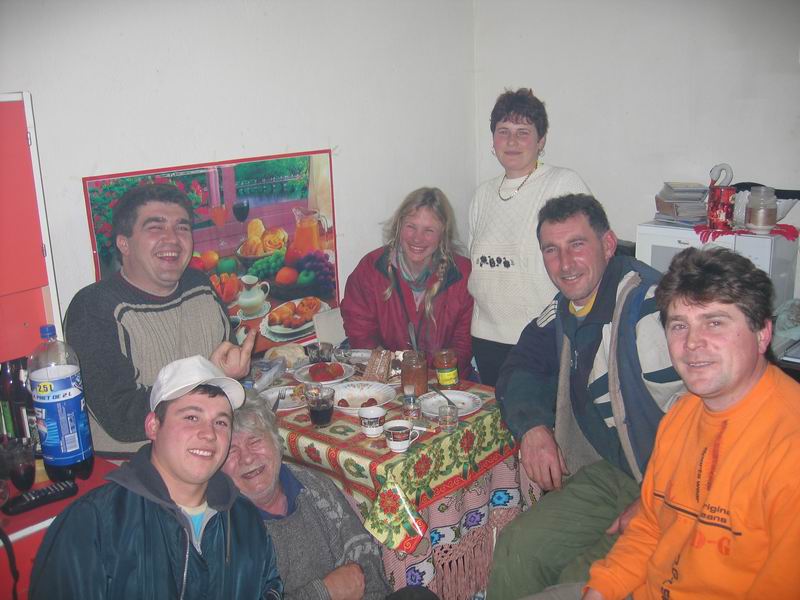
first night in Romania was spent with friendly Slovakians and we drank too much
palinka. On our second night,
John the ferryman let us camp on his land on the bank of the River Mures, a safe
distance from the New Year’s Eve fireworks in nearby Igris.
Serbian families looked after us on the third night,
bringing to our tent a huge plate of cakes,
the best since the patisseries of France.
Many
houses had a plaque on the wall bearing the family name and date of
construction. In Cheverescu
Mare we saw “Jonescu 1938”. With
a name like that these people had to be Welsh exiles we thought.
It was the right time for stopping so we knocked on the door and ended up
staying a couple of nights. They
denied any connection with Welsh Joneses but we weren’t convinced – nicer
people would be hard to find.
We
were working our way from village to village around the city of Timisoara,
heading for the mountains we could see in the East but still on the plain.
At Bucavat, fading light forced us to stop on some common land on the
edge of the village. We were quite pleased to have found a place away from
the ubiquitous seas of rubbish and dead dogs,
but as we went in search of horse food everyone kept telling us to be
careful. It was the first time we
heard the dreaded word “Hot” (thieves).
The basic message was that there were a lot of them about and they were
very fond of stealing horses. Two
cows had recently been stolen from a courtyard in the village and their
butchered remains found the next day near our camp stop.
The chilling thought of waking up in the morning to find our three
friends gone was enough to convince us to stay awake.
It was a long cold night. In
the morning a shepherd disguised as a large sheep drove his flock in our
direction and came over for a chat.
Having
established where we were from and where we were going, he just looked bemused.
“Haven’t you got a car? “
He asked “Not even a cart ?”
In Hungary more people had started to ask why we were doing this trip,
but the Romanians just wanted to know why we didn’t go by car.
If we had, it would have stood out a mile from all the Dacia 1310s. No need for What Car magazine here, no agonising
choices to be made. It seems that
you can have a Dacia 1310 and that is it.
As
we climbed into the foothills of the Carpathians, there were more and more
flocks of sheep, it was just like
home except here they still have shepherds…. and dogs.
The shepherds made no attempt to stop these dogs from barking and biting
at our heels and hooves. We tried to explain that a flick from one of Hanna’s
hinds could leave their dog with a nasty headache, but to no avail.
Still at least the live dogs didn’t smell as bad as the dead ones.
After
what had seemed like for ever on the plain,
we were now finally back in the mountains.
The higher Transylvanian peaks to the East were plastered in snow,
a beautiful sight but one that left us wondering how we’d get through.
How were we to know which tracks would be passable, which would we be
buried in snow? There
were big road routes, but, as always, we wanted to keep off the asphalt.
As
it turned out, we were in luck,
there’d been very little snow this Winter.
We were able to follow quiet dirt roads from village to village, other traffic being wooden carts drawn either by horses with
bells and red tassels on their bridles or slowly plodding oxen.
Where we could, we also took paths up and over the ridges between
neighbouring valleys. Above
the silver birch, beech and pine trees, sheep were grazing the gaps between patches of snow and their
shepherds, surprised to see us, guided
us onto the right routes back down to the next village.
In the sunshine we were reluctant to descend from these idyllic high
pastures with their stunning backdrop of vast forests and shining summits.
Entering
some of these villages was like going back in time,
all the way to Black Adder Series 1:
Hay and maize stalks piled up in stooks, horse carts and bullock carts,
wells, women weaving carpets in the streets,
trotting pigs, barking dogs and gangs
of turkeys, chickens, geese and ducks.
Only the TV aerials on poles, and
the very occasional Dacia 1310, reminded us that we hadn’t undergone a
time-warp. There were
pastel painted houses with vine covered verandas, intricate patterns on doors,
even the guttering was decorated with metalwork flowers and animals.
With
so many horses around, there were no problems finding plenty of food for Audin,
Hannah and Sealeah. If
we stopped outside a village shop, hay, water and corn would often appear
– like a service station for horses.
We were never asked for anything in return except for Audin to cover some
mares. A “scissors” hand
signal was sufficient to explain that this was unfortunately no longer an
option.
We
didn’t do too badly ourselves, it was a time of gifts – sausages, feta cheese, jam, milk,
bread, wine and of course tuica (plum brandy).
We were given so many two litre bottles of tuica we wished we’d had a
stove that burned alcohol rather than kerosene. All these things were produced at home and every family
seemed to have a couple of cows, a pig or two, some poultry, maybe some sheep
and goats. We talked to lots
of people about what may happen in 2007 when Romania joins the EU.
Many here fear that their way of life is going to be changed for the
worse. One man showed us an
extension he’d built on his house with money raised by selling four cows.
Only the big farms are likely to be able to afford to invest sufficiently
to meet new EU regulations and standards, so how will the people in these
mountain villages generate cash ? There
was a feeling that we were perhaps witnessing the end of an era.
In
Ciresu we stopped for a few days to
give the horses a mini break. In the village shop I asked for “laptea”
(milk). “Nu Nu Nu”
went the shouts accompanied by wagging fingers from the men assembled inside
drinking beer, “Natural
natural natural !”
who on earth would spend cash on something you just get from your cow?
Half an hour later, a girl brought a plastic bottle of milk up to our
tent on some communal land high above the village.
Later on, others came with cheese, eggs, jam and onions.
We wondered how Romanians would be treated, camped on a common outside a
British village ?
Inadvertently,
we’d found ourselves copying this habit of repeating words.
Maybe it helps to reduce the length of gaps in conversation when your
language skills are as limited as ours.
Luckily Romanian is quite similar to Italian and we were grateful for the
words we’d picked up back in the Autumn.
We were surprised to find quite a few French speakers too.
It seems that French along with Russian used to be taught in some
schools. We used French with
a man in Poiana who said he hadn’t spoken it since he left school 20 years
ago. He was a real star,
offering us our first bath for you-don’t-want-to-know-how-long.
Later on, Lisa went to the village dance with his lovely daughters, Maria
and Nicoletta.
After
the long spell of perfect sunny weather in the mountains, we hit a run of
bitterly cold days, still dry but biting, penetrating cold.
The drink in our water bottles stayed frozen solid all day.
Riding was colder than walking so we’d alternate, riding for as long as
we could until hand and feet had had enough.
Some times it felt as though our feet would snap in two when we jumped
down from Sealeah and Audin.
After
the three most commonly asked questions in Romania (Where are you from ?
Where are you going ?
Do you want to sell your horses ?).
The next most popular was simply “freeg?
“ (cold ?).
Some evenings when it was minus
10 degrees C outside, it was great to have to struggle out of your sleeping bag,
pull on boots, climb out of the tent through a shower of frost to be greeted by
an inquisitive visitor and the inevitable question “freeg ?”
To which of course, we’d always answer “Nu, nu, nu, cald (hot), cald,
cald !” rather than “well yes I am a bit chilly, now I have had to get out
of my down sleeping bag”.
With
their New Zealand rugs and fleece blankets, the cold dry weather didn’t seem
to bother the horses in the least, although
if windy we always managed to find them shelter,
usually squeezed into a barn with cows, sheep and chickens.
They know when the day's work is done and happily tuck into whatever is
put in front of them, unconcerned by even the most bizarre surroundings.
For forage w often found very good hay especially in the mountains –
the best we’d ever seen – like freeze dried grass, the meadow flowers still
bright colours. Sometimes the only thing we could find was oat straw
but this was still munched happily. Maize
was readily available and often oats too.
We had been worried about keeping the horses in good condition during
winter, but they’ve stayed nice and fat.
In
the village of Bobaita we camped on some common land that was a bit too open for
comfort. About ten o’clock
in the evening, Lisa heard the sound of a rope being coiled and looked out just
in time to see someone running off down the road.
We’d put up a length of rope to keep the horses back off some dodgy
barbed wire and all that was left of it was a frayed end where a knife had
hastily cut it. Thankfully
the rope hadn’t been forming part of the horses' pen but it was still a wake
up call for us; again we stayed up
all night – a rope is replaceable, our horses aren’t.
As
we dropped down to the rolling countryside between the Carpathians And the
Danube, we came across more and more Roma people.
We’d planned to stop in the village of Plopi for a night but when we
arrived, the horses were immediately surrounded by scores of people,
their faces and language reminding us of previous trips to India.
Eyes were popping, hands swarmed over tendons. “Will you sell, sell sell ?
What is your price? Tell
me your price ! You have three
horses you only need two !” Strange
as it may seem we hadn’t ridden three thousand miles just to sell our dearly
beloveds to “Zinganu “ (gypsies) in
South West Romania. It was as
if we’d driven into Bonymaen in Swansea in
a brand new Ferrari. We’d
have loved to stay and talk a bit longer, the
people were bright, smiling and friendly, but to stop here for the night would
be like leaving the Ferrari unlocked with the keys in the ignition and the
engine running. We’d
been warned enough times that horse theft is an integral part of their culture.
We don’t know how true this is, and sadly these people are subject to a
great deal of prejudice, but we didn’t want to find out the hard way.
At
places where we did stay, our hosts made a point of stressing how safe the
horses were. “Only good
people in this village” they’d
say “But be careful in the next
place, there are bad people there “.
So many people asked us how much the horses were worth,
how many euro ? A question we always avoided answering.
Money questions were a regular feature in Romania:
“Are you sponsored ?” “How
much does the trip cost ?” “
What is your salary ?” “What
does a farm worker earn in your country ?”
In
Segarcea, we stayed on a nine thousand hectare farm employing 200 people full
time. They worked
twelve hours a day, six days a week for about 100 euros (70 pounds) a month, an
hourly rate of about 20 to 25 pence. It was almost embarrassing to have to tell them that
the minimum wage at home was 20 times that amount.
Our
last stop in Romania was at the border town of Betchet on the River Danube, four
times wider here than where we’d last crossed it in Hungary.
Despite the need for vigilance and a few cold nights deprived of sleep, we were left with memories of the kindness and generosity of
the Romanians. Every day
we’d been sent on our way with a “Drum Bun !”
(Bon voyage) and we
knew they meant it.
Thanks
to Mr Caucescu, there was a distinct lack of nostalgia for Communism amongst the
Romanians we met. But right at the end we did find one fan.
It was 10 in the morning and the border vet in the “sanitary control”
office was already half gone. On
his desk were a bottle of Brandy, a jumble of papers and most of his beer belly,
a TV was blaring in the corner.
After telling him we were heading for Turkey, Syria and Jordan he wagged
his finger a few millimetres from my nose and warned me about the
“Musselmen” and his political
views began to be revealed. “Bush,
Blair – Superrrr !” He
moved swiftly onto the ‘Zinganu" (gypsies)
“Caucescu – superrrr !”
At that point I tried to get him to focus on stamping our papers.
I guided him to the right page on Audin’s passport and suggested he
could stamp it. “Harry,
Harry, Harry, stamp, stamp, stamp, nooooo promlema !”
His stamping arm waved wildly, rose worryingly high above his head and
came slamming down. In the
nick of time I managed to move the passport to ensure that it, rather than his
desk, was stamped. This
team effort was repeated twice more and he came out to see the horses.
He was still saying “Seleaah, Seleaaahh, Seleeaaaahhh! “ to himself
as we led them onto the ferry and chugged slowly over the river to Bulgaria.
His stamping arm waved wildly, rose worryingly high above his head and
came slamming down. In the
nick of time I managed to move the passport to ensure that it, rather than his
desk, was stamped. This
team effort was repeated twice more and he came out to see the horses.
He was still saying “Seleaah, Seleaaahh, Seleeaaaahhh! “ to himself
as we led them onto the ferry and chugged slowly over the river to Bulgaria.
|
 c1939 30Dec04
 |
 c1940 30Dec04
 |
 c1948 30Dec04
 |
 c1978 31Dec04
 |
 c1984 31Dec04
 |
 c1993 3Jan05
 |
 c2026 7Jan05
 |
 c2029 7Jan05
 |
 c2040 8Jan05
 |
 c2048 8Jan05
 |
 c2049 8Jan05
 |
 c2054 8Jan05
 |
 c2057 8Jan05
 |
 c2067 9Jan05
 |
 c2069 10Jan05
 |
 c2081 12Jan05
 |
 c2102 13Jan05
 |
 c2108 13Jan05
 |
 c2116 15Jan05
 |
 c2118 15Jan05
 |
 c2137 21Jan05
 |
 c2149 22Jan05
 |
 c2154 22Jan05
 |
27
January to 22 February – Strange Uncle Bulgaria
Perhaps
we should have gone to Tobermory instead.
The policeman at the border post insisted that, as tourists, we must have
a police escort for our whole time in Bulgaria.
When we finished laughing he explained that this applied to any foreigner
travelling by foot, bicycle or horse and was purely for our own benefit, to
protect us from “bad peoples”.
Our escort car arrived and the argument continued.
Did they really want to drive along behind us for three weeks at 5km/hr?
Did they have a 4WD for the off-road sections? Did they have a tent? Painfully
slowly the reality began to sink in and they finally agreed to let us go,
settling instead for showing us the first couple of junctions on the way out of
Oriahovo.
In
Bulgaria, real winter finally caught up with us and gave us a big hard kick up
the backside. Even
down on the Black Sea coast they had snow, more than any time in the last fifty
five years. Where
we were, they were used to snow but not this much; it snowed solidly for three
days leaving half a metre of the white stuff all over everything.
It was a winter wonderland but to make any kind of forward progress we
were forced to stick to the roads.
Too dangerous to ride, all five of us slipped and skidded on the
hard-packed ice.
It wasn’t pretty, Sealeah and Audin are not going to be the next
Torville and Dean and when sprayed with showers of grit from the big scary road
scrapers they didn’t think it was very funny at all.
The
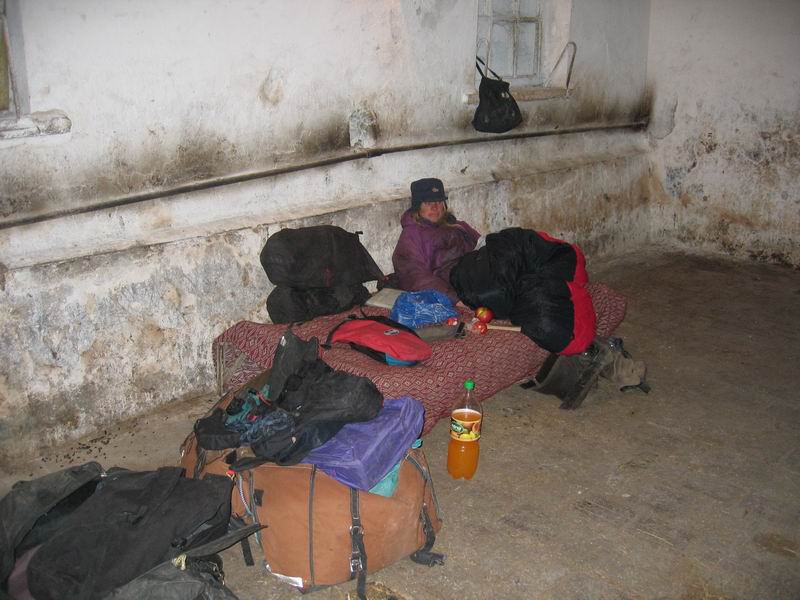
snow also forced us inside at night, into all kinds of strange places.
In Kneja, it was a huge shed full of buffaloes, cows, goats, chickens,
dogs – a whole farmyard’s worth under one roof, not the best recipe for a
good night’s sleep.
In Barcach, there was a room in an abandoned house for us, with the
horses squeezed into a tiny shed downstairs with the sheep.
In Gabrovo, the five of us shared a warehouse in a car breakers’ yard
with a collection of smashed up Volkswagens and Peugeots.
We
were in no position to be fussy, it was hard to find places.
Farms are not dotted about like in Britain, all the houses are packed
closely together in the villages.
On the edge of some villages are former state collective farms but many
of these are now abandoned ruins.
Village homes rarely had room for three visiting horses.
Another phrase entered our multilingual trip vocabulary: “Nema tuk!” (nothing here!).
Our
limited language probably didn’t help but we found the Bulgarians took a long
time to get their heads around us.
We were ‘touristi’ so we
must need a hotel.
It was hard to get across that we just wanted to get the horses sorted:
hay, water and oats, corn or barley – “don’t worry about us”, we tried
to say, “we can sleep anywhere and no, we won’t be cold, we have warm
clothes, sleeping bags…”.
To be fair, in the small villages along our route, they probably hadn’t
come across great numbers of Welsh horse travellers.
Communications
were simplified for us in Pisarovo where we met an english-speaking ex-fighter
pilot who’d just retired from training pilots in Ethiopia to fly Mig jets.
He bombarded us with gifts, including a very old looking
English-Bulgarian phrasebook.
We had a flick through; how could we fail with these traveler’s
essentials:
“Yes,
I am a member of the British Communist Party”
“Where
is the director of the agro-industrial complex?”
“Please
choose a nice pot of cyclamens for me.”
“Who
are the well known Bulgarian cartoonists?” and, last but not least;
“Excuse
me, where did you get that fish?”
Just
outside Lovech, on an old state farm, Issem kindly invited us to share his tiny
one room accomodation.
Outside it was snowing;
inside, the wood stove was blasting, it wasn’t hard to accept.
But the following day his wife and three kids returned and things became,
well…cosy. Issem
begged us to stay and sleep in the room but it was hard to see how it could
sleep five let alone seven.
So it was back into the cowshed with the horses for another noisy night
with big-barn soundtrack – cows shitting, hooves scraping, dogs barking, rats
scrabbling. We
stopped at Lovech for three days for sixteen legs, weary from days of ice
skating to recover for a while.
But while we stopped the snowing didn’t.
We kept hearing the name Shipka on Issem’s radio, this was where we
were heading and the road to it was now blocked with two metres of snow.
Between us and Shipka were the ‘Stara Planina’ (Old Mountains), the
highest remaining barrier on our way to the sea.
For
the next five days through the mountains the sun shone from a bright blue sky
but this came as part of a package deal, the other part being cold, very cold.
The coldest night in a run of cold nights was in the high village of
Musga. We
arrived late and the men standing around the woodstove in the village shop told
us there was nowhere to stay,
another ‘nema tuk’.
While I was in the shop, Lisa’s highly trained hay-seeking eyes picked
out a barn and open-fronted shelter.
The men in the shop said no problem, help yourself, so we waded through
the thigh deep snow, unloaded the horses, piled up the hay, carried a couple of
buckets of water from the back of the shop and dived into our sleeping bags.
A
three litre bottle of lemonade I’d bought in the shop froze solid in a few
minutes. We
kept our kerosene stove blasting, melting snow for hot water to keep thawing the
ice in the horses’ buckets. Fully clothed and submerged in our down sleeping
bags, we were warm enough to sleep.
But we should have slept in our boots as well because they were frozen
hard in the morning.
Everything took longer with frozen fingers but when we finally got moving
it was a relief when the hot aches came.
We heard later that down in the valley below us at Sevlievo, a
temperature of –34C had been recorded that night, the lowest for more than
half a century.
As usual, our chestnut friends just got on with it, warm in their rugs,
not a single shiver.
By this stage Audin was hairier than a grizzly bear and the others
weren’t far behind.
After
a long pull from Gabrovo, we made it over the Shipka Pass where, in 1877, the
Russians had beaten back the Turks in a famous battle.
It felt as though our own battle with the elements would soon be over.
On the south side of the pass, for the first time in a fortnight we saw
trees that weren’t buckling under the weight of snow.
“It’s still cold”, Lisa said, “but it’s a new, slightly warmer
kind of cold.”
From
Shipka, with the Stara Planina behind us, we’d convinced ourselves that it
would be downhill all the way to Turkey and the long awaited Sea of Marmalade.
But we were wrong, there was one more range in our path, the Sredna Gora.
We reckoned we’d be able to cross it in a day, using a track spotted on
the map. But
the map is not the territory and the territory was buried in snow, covered in
dense forest and completely devoid of people.
By mistake (Chief Navigator takes full responsibility) we found ourselves
on the wrong track, one that went on and on, up and up, became more and more
overgrown and finally, after five hard hours, just petered out.
We tried to thrash our own way through the forest but the valley sides
became too steep.
Decision time; should we stop and camp and try again tomorrow or lose all
the ground we’d gained and go back with our tails between our legs?
There’d be no food for the horses but if we could just get over this
way it would save us a few days.
In the end it was the wolf tracks in the snow that put us off a bivouac
– we’d heard they were particularly hungry this year due to the bad weather
and we weren’t too keen on providing them with horsemeat for dinner.
So, for the first time all trip, we admitted complete defeat and returned
for another night at the farm we’d left that morning.
But
while we hadn’t made an inch of progress for our efforts, the horses had loved
every minute. So
happy to be off the road they did everything asked of them and more; ploughing
through the snow, punching through the ice on river crossings and powering
through all the trees that got in their way.
“Why can’t we do this every day?’ they asked.
Their energy and enthusiasm seemed to be limitless.
It
was February 14th and as if we hadn’t had enough action for one
day, there was a St Valentine’s Day Massacre to finish it off.
It was my own fault, I’d just been saying how sorry I felt for
Bulgarian dogs who seemed to spend all their lives chained up,
when we arrived back at the farm to find the four big guard dogs very
much unchained up.
Not only that, they took their job seriously and were in full attack
mode. When
Audin was bitten, Lisa’s shouts were probably heard back in Wales, but not, it
seemed, in the farmhouse.
From my hiding place behind Hannah I made a run for it to go and fetch
the owner, Ivan, but I was immediately surrounded.
While one of them shredded my trousers, another clamped his jaw over my
calf. Thank
God for leather half chaps or the holes in my leg would have been much bigger
and much messier.
Later, over a glass of ‘rakia’
(some of which was donated for disinfecting the wounds), Ivan said he’d seen
us under attack but…wait for it… “had to go and finish the washing up”
before coming outside – talk about priorities!
After
a brutal day of lashing rain and hailstones we found refuge in the village of
Yulievo on a farm, another ex-collective, now privately owned.
Like others we’d stayed on, the ‘patrona’ (owner) didn’t believe
in getting his hands dirty, there were plenty of workers for that.
This one became known to us as “The Fat Patrona”.
Of course, we were grateful for the hospitality, the warmth of the wood
stove, food for the horses etc etc, but sometimes we have to pay for these
things in non-financial ways.
At dinner time, The Fat Patrona bent his head over a bowl of fatty mutton
and, sweating profusely, shovelled vast quantities of it into his mouth and
ordered us to do the same.
Afterwards he moved on to the pumpkin seeds and a mountain of shells soon
built up in front of him.
He demanded to see our map and insisted on telling us how to get to
Turkey. The
Bulgarian word for ‘here’ is ‘tuk’
or ‘tukka’ and, as his fat
fingers violently stabbed a succession of villages across the map, it was
accompanied by a deafening “tuk, tuk, tukka, tukka, tuk, tuk, tuk, tuk, tukka…”
On and on it went, like a three-wheeled Delhi taxi.
“tuk, tuk tukka…”.
The soundtrack was accompanied by a continuous rapid-fire spray from his
mouth of fragments of pumpkin seeds.
Worst of all, when his finger finally reached Turkey, he came back to the
beginning and started all over again, “tukka,
tuk, tuk, tukka, tuk, tuk….”.
He was just about to start his seventh or eighth re-run when Lisa broke
under the strain and rushed out, saying she had to check the horses.
In the morning, to our astonishment and horror, he insisted on showing us
again - he’d been thinking about it overnight and changed his mind about a
couple of sections.
This time he was armed with a biro and his stabbings and scribblings
managed to obscure what little useful detail there was.
Again, the whole route had to be repeated several times.
When he took our other map and started to trying to mark the precise
locations of all the “bad peoples” in Turkey, it was just too much, we had,
as they say, to make our excuses and leave.
When
the hills ran out, all the charm did too and the landscape took a turn for the
grimmer. Drab,
grey towns full of drab, grey apartment blocks, an immense opencast coal-mining
area littered with rusting wrecks of machinery, faded hammer and sickle murals
on ruined buildings.
It seemed as though all work had stopped twenty years ago and everything
had been left to deteriorate.
To add to the morbidness, when people die, posters of them are put up all
over town so every spare bit of wall is plastered with photos of dead people.
Where was the bright side of life?
In
Romania, people seemed positive about the future but most of the Bulgars we met
just seemed resigned to it all, powerless to do anything to improve things.
There was huge resentment of the ‘mafia’.
Why should 5% of people have everything and 95% have nothing?
The adjustment from communism was clearly a slow and painful one.
Srepka, the third person in Bulgaria to give us a present of socks (were
they trying to tell us something?), summed up what many felt: “Before – no
money, no problem; Now – no money, big problem”.
Sealeah’s
own version of this was “No chocolate, VERY big problem”.
With the world under snow, our grazing stops during a day’s ride had
become a thing of the past so the horses felt fully entitled to a share of our
chocolate supplies.
Sealeah became dangerously addicted.
Even a tiny movement of my hand towards my chocolate pocket soon became
impossible without being clobbered by a chestnut muzzle.
I swear sometimes I just had to think about chocolate and she’d quicken
her step to get into position for mugging me.
Some of the products on sale were good for a laugh.
There was a Bounty lookalike called ‘Coco-Country’
(two convenient sections for easy sharing with your horse), a Kitkat copycat
called ‘Mistake’ (we bought one
and it was) and an energy drink called ‘Pit
Bull’ (how on earth did they think up that name?).
When a lorry passed us bearing a big multi-coloured logo: “We Are The
Toys” we knew that there could be no limit to this plagiarism – though to be
fair it’s possible that they considered this a grammatical improvement on Toys
R Us. Before
the subject of bad food is left for ever, it would be wrong not to warn fellow
travellers about the ‘7 days’ line of products, the worst of which is
without doubt the croissant with filling.
If you can find it at all, the filling is about as big as the kind a
dentist puts in your teeth and the ‘7 days’ surely refers to how long after
baking they leave it before carefully sealing in the staleness.
Our
last good stop in Bulgaria was with Georgi in Pastrogor.
He had a wicked sense of humour but was utterly depressed at the same
time: “Life in Bulgaria very difficult,
everything in Bulgaria broken, life
very hard, everything broken”
- he must have told us twenty times.
He was amused that we had actually chosen to make things difficult for
ourselves by travelling on horses. “Why this very difficult
life?”, he kept asking us.
In the morning he told us that he’d had two cows stolen from inside his
barn by the gypsies.
“These people are very hungry”, he said.
His cup was a lot more than half empty, his parting words: “please
don’t go to Syria, my children!”
But
we had to get into Turkey first and even the run to the border wasn’t easy.
Once again we were forced onto a big road, a bottleneck for all the
trucks passing between Turkey and Europe.
Kapitan Andreevo was the last place in Bulgaria we could stop and the
last place anyone would want to stop.
There was nowhere safe for the horses and nobody had any hay.
In the end we found an empty barn, surrounded by rubbish, half falling
down and sealed up with chainlink fencing.
The local starers seemed to think the ‘patrona’
lived miles away and wouldn’t mind anyway so we broke in.
In the process, our whereabouts became known to some gypsies living in
another abandoned farm over the road.
We closed up the fencing again, this time from the inside.
We
still hadn’t found any food for the horses but it appeared that somehow, the
gypsies were guarding a supply of top quality lucerne hay.
The horses were hungry after a run of bad nights so I had to try and buy
some. Men
came out of the ruined farm buildings.
“Lucerna, lucerna?”, I asked.
Fingers pointed towards by far the scariest looking of all the men.
Apart from his scary head with scary tattoos and scary eyes, he had a
very scary (and very big) knife which he was passing slowly from hand to hand,
clearly enjoying the feel of it in his palms.
He told me to go through a doorway into the barn.
“No, after you’, I insisted.
But sure enough, inside the barn was the secret stash of hay.
They demanded euros and for some reason the big knife seemed to make all
my haggling skills disappear.
Back
at our luxury ruined barn (the Kapitan Andreevo Hilton), Lisa was doing her best
to fend off a drunken gypsy and his bottle of ‘rakia’.
My return put an end to his unwelcome advances but he wouldn’t go
away and he wouldn’t shut up.
He finally left but a good night’s sleep wasn’t really on the cards.
At one in the morning our friend returned, slumped down on a load of hay
that he’d carried on his back, muttered non-stop for twenty minutes and then
passed out. At
two in the morning he woke up and tried to break down the chainlink fence
keeping the horses in.
Our shouts sent him running off into the dark.
After that it was all peace and quiet, apart from the sound of very
expensive hay being munched, rats scrattling around in the roof and small bits
of masonry from the collapsing barn landing on our heads.
After
Lisa’s reconnaissance mission to talk with the vets at the border, we endured
another similarly unpleasant and sleep-free night in the house of fun.
It was from this somewhat-less-than-marvellous platform that we launched
The First Turkish Campaign.
Our
first experience of Turkey was five long hours at the border trying to penetrate
a dense wall of bureaucratic negativity. This
time, Lisa drew the short straw and did all the talking while I dozed in the sun
with the horses. Men in dark suits
rolled up in cars and then disappeared into meeting rooms to discuss our fate.
While we waited, some journalists turned up from nowhere; photographs,
questions, more photographs. Some
power crazed iındivıdual was set against us being allowed in and we
didn’t know why. Reason and
common sense were no match for their stubbornness.
Utterly dejected, we trudged back under the grand, crescent moon and
stars archway, back through Bulgarian customs and back to the crumbling fleapit
barn we’d prayed we’d never see again.
Lisa had picked up a free map in one of the offices; “Welcome to
Turkey”, it said on the cover, “Holiday Paradise Center”.
Unable
to sleep for a third consecutive night, we held a team meeting in the dark hours
before dawn. Three of us didn’t
contribute much: Hannah (aka "Jobsworth") felt she had to keep watch
in case of gypsy attack, Audin was too busy playing with his tongue on the chain link
fence and Sealeah needed time to lie down and re-live the day’s excitement in
her dreams. As usual, it was left
to Lisa and me to make all the hard decisions.
At the frontline, Turkish resistance had been strong, we now knew we’d
have to be well prepared for a second assault and approaching from a different
flank could increase our chances of success.
So, after hours of debate, we concluded things in just a minute - we were
in no mood for a repetition so without hesitation we agreed what was needed: The
Thracian Deviation.
The
ancient region of Thrace included parts of present day Bulgaria, Greece and
Turkey. Luckily, the latest border
change had left a big lump of Greece stretching up north to rescue us.
Our Thracian Deviation involved retreating from the Turkish front,
backtracking west for a day in the rain through the miserable Bulgarian town of
Svilengrad and dropping south into
Greece. The border was a breeze and
suddenly we were back in shiny happy Euroland.
Just
after dark we arrived in the first (last?) Greek village, Ormenio, where the
entire male population was in the café. Within
a few minutes, only half the male population was in the café, the other half
were outside trying to help us. I
was led to a barn and given two huge bales of ‘trefilli’ (lucerne
hay) while, with full approval, Lisa parked the horses on the football pitch.
“Of course nobody minds”, Harry told me, “this is Greece.”
In Greek, Harry is spelt a bit like a maths lesson: ‘X a p i’.
Later, in the café, where the men seemed to make one tiny cup of coffee
and a glass of water last all night, Xapi gave me a quick run down of the
alphabet and I wrote down a few words. We’d
had no intention of coming to Greece and had crossed the border without knowing
a single word. Yet another
different alphabet was a bit of a pain though.
We’d only just got to grips with Cyril’s funny letters in Bulgaria
and now we were having to wrestle with betas and thetas, epsilons and pies.
We
were heading south but soon realised that all the freak snow in Bulgaria was now
melting and doing the same. The
River Ardas coming down from the Rhodopi mountains was raging whitewater.
The River Erithropotamos was unfordable and it forced us all the way down
to the big River Evros. This had burst its banks and the flooding stretched for
miles, all the way across to Turkey.
With the wind whipping up white horses it was like being down by the sea,
only one with houses and trees in it. A
TV reporter and cameraman, out to talk with flood victims, stopped us on the
road and a couple of minutes later we were being interviewed about our trip.
When asked how I found Greece, I should have said that we just rode down
to the end of Bulgaria and turned right but (a) this joke is too ancient even
for Greece and (b) I didn’t think of it until about thirty seconds after the
interview had finished.
With
the Evros floodwaters on the left and the foothills of the Rhodopi mountains on
the right, we made our way down to the town of Tihero. Within striking distance of the Greece/Turkey border crossing
at Kipi, it was the perfect location for the lengthy planning stop needed for
the Second Turkish Campaign. The
horses had a small paddock, access to shelter and top quality food and less than
a stone’s throw away the humans, thanks to the incredible generosity of the
lovely Sophia at the Thrassa Hotel, found themselves in a luxury suite
overlooking a lake. Hot water, soft
bed, calming music…it was too much to take in.
How could this be happening to people who sleep with buffaloes and rats?
Determined
to avoid another border battle defeat, we threw ourselves into the campaign
effort. Sophia at the hotel, Meni
and friends at the stables, Chris from the internet café - all of them helped
us well beyond the call of duty. Without
them, a difficult task would have been a hundred times harder.
We heard about others with horses who’d been turned away at the border
and didn’t want it to happen to us. This
time we were determined to try diplomacy before returning to the frontline.
Via the EU in Brussels, we made contacts in the Ministry of Agriculture
in Ankara and, after a bit of email/fax/phone to-ing and fro-ing, everything
started to sound more hopeful. Mayors
and Heads of Prefectures and all kinds of ‘Grands Fromages’ (probably feta)
on both sides of the border soon knew about our situation.
When the blood test results finally came from the lab in Athens, the
health certificates could be signed and the written permission from Ankara
followed. If Heracles was still
around and scratching about for another ‘labour’ to keep him motivated,
trying to get a horse into Turkey would be a fitting challenge for him.
After two weeks of effort, it was time for take two.
Getting
through the Greek side of the border required another visit to the ministry vet
or ‘Anthi the Fire-breathing Dragon Lady’ as she is otherwise known.
We’d paid a visit a few days before and had been greeted with a barrage
of shouting, the general gist of which was that everything we wanted to do was
totally impossible. But she blew hot and cold.
After disappearing into a backroom (presumably to inject herself with a
large dose of some kind of sedative) she returned all smiles and even made us a
cup of coffee. These vets often
have several posters of horse / dog / cat breeds on their office walls but
Anthi’s wall boasted only one: fish species.
How many people came traveling through this border post with fish?
I can hear her now “Excuse me, where did you get that fish?”
Today, because it was a public holiday, and she’d had to come to work
“only for you” she demanded money “only for gas”.
Compared to the direct bribe demanding approach of the Romanian vets,
this was refreshingly subtle.
On
the Turkish side, it was a simple case of waiting a mere four hours for the vet
to turn up. He’d been told by
Ankara to let us in and, now stripped of power, just oozed resentment.
He brushed aside all the passports and health certificates and just kept
saying “camion (lorry), you must have camion”.
He could get one for us for the right fee.
Bless him; he must have needed the full four hours to think that one up.
Fortunately, we’d insisted that our permission stated we’d be with
the horses on foot. It was
stalemate for a good hour but in the end he cracked before I did and we were
given the green light.
By
now the sun was setting behind us in the Greek hills and we had to find
somewhere to stop but we didn’t care; at last, we were in, it was T-day.
Spring
Turkey – Ipsala to Pamukkale –14 March to 26 April 2005
“Hello.
Whatisthis? Goodbye.
Whatisyourname? Whereareyoufrom? Hello. Hello.”
Shuffle and repeat. And
repeat and repeat and repeat. Answering
these questions makes no difference; the Turkish children just love the sound of
these English words so they keep on saying them, over and over.
It was our first night in Turkey and the village muhtar (mayor)
had shown us to a scruffy patch of ground behind the mosque.
The horses weren’t too impressed with this new country; they had to be
tethered to trees and there was no hay to be had, only saman (straw). There
wasn’t much peace either. We were
visited at least ten times that evening by more or less the same group of kids.
Every so often they’d all walk off with a loud chorus of goodbyes, only
to return ten minutes later for another fun round of what-is-your-names.
This
was just a taste of things to come but at least we were amongst friendly folk:
endless questions, beeping horns, waving hands, cafés full of men demanding we
stop for a çay (black tea – pronounced chai). If you want to find out how to say ‘very beautiful’ in
lots of languages, just keep riding from country to country on a good looking
Arab horse – the words “çok güzel!” rang in our ears all day.
After
a final day or two on the plains of Thrace, we were soon back in hills, winding
up through pine forests and keeping our eyes peeled for eagles. On reaching the crest of a ridge, we were rewarded with a
fine view: the Aegean, sparkling in the sun.
It was our first sight of sea since we’d cantered across a Brittany
beach nine months before. That had
been a wild day, our faces blasted by a mixture of Atlantic spray and Atlantic
rain. The Aegean was much more
civilised; by late afternoon, after a long descent on a hard road, we reached an
empty beach. The waves lapping the
shore were only just bigger than ripples so we rode straight in, tired tendons
enjoying a saltwater soak.
To
avoid all the bigcityness of Istanbul we’d decided to head down the Gallipoli
Peninsula instead. This forced us
back west for a couple of days but it was great riding; the horses were fresh
and strong after their long forced rest in Greece and there were good dirt
tracks from village to village. We
stayed high along the spine of the peninsula and now we were spoilt for sea
views; our new friend the Aegean down below us to our right, the Sea of Marmara
tempting us on our left. The map
had come to life, the geography had jumped out to meet us.
There
was plenty of history here too. We
were riding through a weird moonscape of bare hills and steep gullies that had
seen some horrific battles during the first world war.
It wasn’t hard to imagine how grim it must have been trying to fight in
this terrain. One hundred and
thirty thousand men lost their lives here; Turkish and allied soldiers, many of
whom were from Australia and New Zealand (the ANZACS), following orders of
British generals as part of an ill-conceived plan to take Istanbul.
Today, the cordial relationships between the countries involved and the
dignified memorials make such a tragedy seem all the more senseless.
These
land battles had followed the defeat of the British Navy by the Turks in the
Narrows of the Dardanelles (Hellespont) on 18th March 1915.
Ninety years and a day later we’d reached the end of one continent and
this short stretch of water was all that separated us from the next.
With fortunate timing, we rode through the town of Eceabat and straight
onto a ferry. The boat was packed
and Audin, Hannah and Sealeah were centre of attention, standing on the open
deck behind all the lorries and buses. Seasoned
sailors by now after their crossings of the English Channel and twice over the
Danube, they dozed in the sun as Europe faded behind and Asia grew bigger up
ahead.
Due
to the 90th anniversary celebrations, Çanakkale was packed and we
had to fight our way through the crowds on the quayside, trying to find a spot
big enough for the five of us. A TV
crew suddenly appeared from the throng and I left Lisa to answer the questions
while I escaped to try and buy a map. There
was a celebratory atmosphere and we rode off down the busy high street to claps
and cheers, watching backwards-running cameramen bumping into cars and lampposts
as they tried to film us. It was a
big town, the ferry had dropped us right in the middle and now it was getting
late. After a long slog up a big
road we finally found enough grass for a night, just as the sun disappeared
behind a Gallipoli hill. Mug of tea
in hand, we looked down at the lights of the ships gliding through the
Dardanelles and switched on our tiny radio:
“…and now we go to rugby union.
Wales have beaten Ireland at the Millennium Stadium in Cardiff, winning
the Six Nations Grand Slam for the first time in twenty seven years…” YES!
They heard our shouts in Cardiff. Some
days are just great.
A
quick canter along the coast the next day brought us to the ancient city of Troy
where, around 1250BC, the Greeks needed ten years of fighting and a crafty
wooden horse trick to gain entry. All
we had to do was pay ten million lira. The
horses had to wait outside but they didn’t mind too much; they had a safe
field, the grass was tasty and – unlike me - none of them had just read the
Iliad so they wouldn’t know what all the fuss was about anyway.
We were soon re-united with our chestnut chargers, crossers of
continents, and we were there ‘far on the ringing plains of windy Troy.’
By
this point I’d started spouting like Homer and, immensely annoying though it
was for Lisa, I couldn’t stop. In
the lead was hot-blooded Hannah, cargo-carrier, bearer of baggage, tangler of
tether ropes. Not far behind came
the Dancing Queen himself, able-bodied Audin, extender of the tongue of
friendship. Hot on their heels came
swift-footed Sealeah, turner of heads, grazer of grasses, mane flowing like a
river of gold. The little
procession crossed the plain and climbed easily into the hills.
The sun went down and all the ways grew dark. At the Welsh encampment that night, the hunger of accursed
bellies was soon satisfied and the gift of sleep came quickly to all.
When early-born, rosy-fingered Dawn appeared, lovely-haired Lisa, healer
of horses, spoke and her words were winged, they did not leave her lips for
nothing: “Husband? How long are you going to carry on with this claptrap?”
Between
Troy and another ancient city, Assos, we followed tracks that took us along
miles of olive groves, along cliff tops and down onto deserted beaches, some of
which went for miles although the sand and shingle was a little soft in places.
Spring was exploding all around us: the welcome sight of green green
grass and huge carpets of anemones – purple, white, pink, red.
The new grass allowed a return to our long picnic / grazing stops and the
strong sun brought back attacks of the familiar post-lunch flopsidaisicalness.
We
spent one memorable lunchtime at the ruined harbour of Alexandra Troas. Ancient columns and huge stone slabs stuck up from the grass
or lay scattered, half-submerged in the water.
Spring flowers brought bright dashes of colour and tortoises scurried
everywhere, trying to make up for lost time after a long hibernation.
It felt like a kind of emergence for us too - the hard winter in the
Balkans was finally behind us. Best
of all we had this magical place all to ourselves.
Only later, looking it up in a well known tourist guidebook, did I find
out why; ‘probably not worth a special visit’ it said.
Thank you to whoever wrote that.
Just
before reaching Assos, our spring joy was suddenly shattered.
Lisa writes:
That
afternoon Sealeah developed a rapidly worsening lameness.
There was no obvious lesion on her leg or in her hoof, but on arriving at
our olive-grove bivi spot I pared out the foot and found a small tract starting
at the edge of the frog (spongy bit in the middle of the hoof) and penetrating
deep into her foot. Some pus came
out and I pared out as deeply as possible but my blood was running cold and I
felt sick with fear – I knew if this was just a shallow pocket of pus where
some glass or sharp stone had cut into her foot she’d be fine, but the tract
was heading towards the navicular bursa (capsule of joint fluid) and tendon
sheath; if these had been penetrated the consequences, if not treated
surgically, would be dire for Sealeah. In
our olive grove hideout I didn’t even have the equipment to establish whether
these structures had indeed been breached.
Immediate transit to a sufficiently equipped equine clinic was not an
option here so I did what I could with the vet kit we had (this is vast but in
the circumstances seemed pitiful!).
Needless
to say I didn’t sleep a wink but spent the night wracked with worry and
cursing myself for putting our precious mare in this position.
Thankfully she steadily improved during the next day and it became more
and more obvious that vital structures had not been penetrated – relief!
That night was one of only two occasions (the other being the
traffic-congested hell in parts of north-east Italy) when I doubted whether we
should have risked our horses on such a journey.
Having said that, as anyone who knows horses is aware, everything we do
with them – jumping, breeding, racing, hacking – carries a risk ( I have
even seen horses break legs when turned out alone in flat well-fenced paddocks)
and at least on this trip we’re with them twenty four hours a day and their
welfare is our constant priority.
The
other side of the coin is that there is absolutely no doubt in our minds that
they are enjoying this journey. Moving
along in a small group between grazing areas is a fairly natural life for a
horse. They are curious and social animals who enjoy novelty and
varying terrain. Sealeah’s
favourites are narrow winding tracks through woods, scrambling up steep mountain
tracks and, best of all, chasing after nosey calves and sending them back to
their own herd where they belong. All
three, even after all this time, dance like looneys when we hit a wide riverside
track or open grassland where they know a good gallop is on the cards.
They’re also very affectionate towards us, alert and concerned if any
one of us five is separated. They
greet us with a whinny on our return – all the more enthusiastic if we have a
plastic carrier bag of shopping in hand. They
stand over us if we lose the battle with our eyelids after lunch and at night
they gather round the tent and we have to crawl past twelve legs to get the day
started. The intensified
relationship with the horse is a major pleasure of traveling like this, as
anyone who has done so could testify.
Assos
turned out to be the perfect place for a brief rendezvous with Lisa’s
parentals, who’d just brought a large quantity of drugs into the country. To make matters worse, they claimed to be carrying it for
“somebody else”. Really! - at
their age you’d think they’d know better.
Hadn’t they seen Midnight Express?
As responsible son-in-law there’s only so much you can do: warn them
about the dangers, try to make them realise it’s just not worth it, even if it
is what all their friends are doing. But
to be fair, they didn’t have any choice, daughter Lisa had spoken: the vet kit
had to be replenished.
We’re
very grateful to Diana at the homely Old Bridge House Pansyon who put us all up
/ put up with us all while we sorted equipment, swapped winter for summer gear
and shod the horses (who’d taken over and eaten half of the front garden).
The in-laws weren’t the only distinguished visitors to Assos:
Aristotle lived here for a few years, philosophising down at the
gymnasium, and St Paul popped in for a bit of pagan-converting on one of his
jaunts around the Med.
After
Assos, we continued around the Gulf of Edremit, trudging through a concrete
madness of hotels, restaurants and holiday apartments – the coastline had been
thoroughly ruined. It was a relief
to escape eastwards into the mountains and find some peace again.
Between Edremit and Pamukkale we crossed five separate mountain ranges,
each with it’s own distinctive character.
The Madra mountains were a wonderland of pines and huge granite boulders;
the Yunt hills were gentle, rolling and over-grazed; in the Çal and Boz
mountains the olive groves gave way first to grazing pastures then to scrubland
in narrow gorges and finally to pine forests; the Aydin range was a maze of
steep-sided hills with orchards of fig trees planted on crazy slopes.
Between these ranges the broad valley floors were flat and fertile, well
watered by the rivers flowing west to the Aegean.
Moving
up and down mountains requires energy and finding enough horse food was
sometimes a challenge to say the least. Yes,
the spring grass was growing but when it came to eating it there was some
serious competition around: cowherds, shepherds and goatherds drive their
livestock to every accessible patch of land.
Anything that looked promisingly green from a distance usually turned out
to be enclosed, protected by a barrier of cut thorn branches.
If we failed to find good enough grass for a night we’d have to go into
a village, but often the only forage available there would be straw (not enough
food value for the amount of work we were doing).
Luckily, somehow or other, we did nearly always manage to find enough
grass before ‘all the ways grew dark’.
Hannah can carry enough grain and oil for three or four nights and this
gave us enough time to cross each range and the freedom to stop anywhere, grass
and water supply permitting.
This
approach also gave us some precious evening peace, some respite from the daytime
barrage of questions and staring and more questions and ‘come here!’
whistles and vigorous flagging-down demands for us to stop and drink chai.
The constant attention could be wearing but the Turks’ only
‘fault’ is being too nice, too friendly, too interested.
They didn’t know we’d had the full round of questions several times
already that day, or that if we stopped at every call for chai we’d
need three years to get across the country.
Sitting
around in cafés all day fiddling with worry beads while the women are doing the
work is a serious matter for Turkish men; a chai-rejection has to be
handled quite carefully to avoid giving offence.
One evening, at what we thought was a well-concealed bivi spot - a high
patch of grazing some two hours ride from a village – a man appeared through
the bushes. He’d driven round in
his lorry and now he’d found us. He
demanded to know why we hadn’t stopped for a glass of chai with him at
his café in the village. We tried
to explain but clearly not very successfully. “Nescafe, you could have had Nescafe,” he said, before
moving on to the question of why on earth we were camping up here in this
terrible place instead of staying in the village.
“You’ll be cold at night” was his first attempt.
We pointed out our sleeping bags. “There are foxes…and dogs ” he
tried next. We pointed out Hannah,
our Head of Security and one of the best in the business.
He grabbed our dictionary. “Military
zone, this is a military zone.” We pointed out the distinct lack of soldiers,
signs or anything remotely military-ish. He
was getting desperate, his searching fingers flicked frantically through the
pages. Then, suddenly, he found it,
the word he was looking for, here was his trump card:
“Insects!”
“Insects?”
“Yes!
Insects! Here!”
There
wasn’t a single wee buzzer or creeper or crawler in sight.
We shouldn’t have looked at each other. We laughed.
We just couldn’t help it.
In
some of the remoter mountain areas (cretinism a speciality) our arrival was just
a bit too exciting to cope with and a great furore had to be made. Passports had to be produced for the muhtar, our names
and numbers taken down in a pointless books and the whole matter discussed over
the telephone with the Jandarma (military police) before we could be
allowed to carry on. On a few
occasions, concerned villagers must have reported the presence of a strange tent
in the vicinity because the Jandarma have turned up to investigate, with
grave-looking villager in tow. Why
they have to come at one o’clock in the morning is anybody’s guess – maybe
sleep deprivation is part of the interrogation technique they learn at training
school. The first time this
happened there were six men with machine guns so I pretended to be asleep and
left Lisa to do all the talking. The
next time, it was my turn and things were going pretty well until I was asked
whether we had any children. At
this point Lisa wondered quite audibly and very colourfully whether this
information was strictly necessary for his little notebook, especially at one
o’clock in the b*&%*+d morning.
These
incidents were, however, mere islands in a sea of warmth, friendliness and
hospitality. Of course, many of the
chai invitations were accepted, usually where we could also get on with
something else like watering the horses or buying food at a village shop. By ‘we’ here, I actually mean Lisa, because I was the one
who had to do all the difficult tea drinking – it’s a man’s job in Turkey,
a cultural thing that you can’t argue with.
After shaking hands with the whole café, it would be Horse Travelers’
Question Time. Where are you from?
Where are you going? Why three horses? Where do you sleep?
Isn’t it cold at night? Aren’t the horses cold at night? What do the
horses eat? Are you a tourist? What is your name? How much money were the
horses? Is Turkey beautiful? What
is your job? Etc etc.
This
first question is the hardest. Ever
since we left Italy, the only people who’ve heard of Wales are those with an
interest in football (OK, apart from one man in Romania who’d seen Wales on
the Discovery Channel). One man’s
eyes lit up when I said we were from Wales.
“Yanroosh! Yanroosh!” he exclaimed, followed by a very realistic
flying header impression. “Ah,
yes, Ian Rush, one of the best” I said. (The
next thing I knew, he was leading me to his field, swinging his sickle and
handing me a big bunch of Lucerne for the horses.)
The Turkish word for Wales is ‘Galler’, i.e. Gauls, the Roman
name for the Celts and meaning ‘barbarians’.
So we’re basically telling everyone in Turkey that we’re barbarians,
no wonder they look worried. Usually,
‘Galler’ just leads to blank looks or, even worse “Allmanya?
(Germany)” so we try ‘Brittanya’ and they say “Italya?”
In the end we’re forced to give up and say “Ingilterre yakın
(near England)” with lots of stress on the ‘yakın’ and
as little as possible on the ‘Ingilterre’.
But as soon as you’ve said the Ingilterre you’ve blown it,
it’s already too late and the buzz goes off through the crowd, Ingilterre,
Ingilterre, Ingilterre…
Sometimes,
on trying days, we just give up
early in this process. There are
whole villages and entire towns that think we’re German, French, Italian.
But first prize in the wildly-off-the-mark competition must go to a man
met on the road to Bergama:
“Where
are you from?”
“Galler”
“Azerbaijhan?”
“Er…no.”
Finding
places to stop for more than one night isn’t always easy but we managed it at
Bergama, Sardes and Pamukkale. These
are all well known tourist sites and they provided a bit of added historical
interest on top of the usual rest day chores.
Sardes was capital of the Lydians, one of the many kingdoms established
by migrating Greeks sometime after the fall of the Hittites. Phrygians, Ionians, Lydians, Lycians, Pamphylians, Hittites,
Araldites, Loctites...you can very easily get stuck trying to remember all these
names. The first ever coins were
minted by the Lydians at Sardis and, judging by the size and number of the
conical burial mounds at Bin Tepe (A Thousand Hills), it’s more than likely
they spent most of them on funeral arrangements.
Across
the river from Bin Tepe and just outside a small village, we’d spotted a
walled compound with suspiciously long grass.
It looked like a graveyard but without any graves (the longest grass in
Turkish villages is always in the graveyards – this just isn’t fair, horses
need grass, dead people don’t). It
was late in the day, it was good grass, we went for it anyway and set up camp. We were spotted within about thirty seconds of course and
when the first, inevitable, delegation of visitors from the village arrived, we
discovered the compound had housed an old school. When the twenty first delegation of visitors had finally
left, one ‘rest’ day later, we were worn out, shattered; the longest gap
between visits had been no more than ten minutes.
It was a Saturday and every kid in the village had wanted a ride; every
teenager had come to try out their ‘whatisyournames?’ and their ‘whereareyoufroms?’;
every geriatric had come to tell us that they used to go to school on this very
spot fifty years ago and one old woman had come simply to sit down, get her
knitting out and have a good long stare at us.
Mistake number one: stopping within 500m of a village.
Mistake number two: trying to have a rest day when the kids aren’t in
school. Mistake number three:
showing the first of those kids Sealeah’s ‘shaking hands’ and
‘kiss on the lips’ tricks.
(Somewhere
back in the distant past when the mountains were French I taught Sealeah to lift
her right foreleg when I said “right” and her left when I said “left” - teaching
her the difference between right and wrong is proving a lot trickier.
A bit later on in Italy I blew her a kiss over a fence, she leaned over
to give me a big smacker on the lips and I made the mistake of rewarding her
with a bite of my apple. She never
forgot. By then she was shaking
hands in English, French and Italian - I’d realised she wasn’t taking a
blind bit of notice what I said, just watching my arms when I pointed to each
leg. So now Slovenians, Hungarians,
Romanians, Bulgarians, Greeks and Turks have also seen that this clever horse
can speak their language.)
The
Saturday kids at Sardes thought this little routine was just grand: sar (right), sol (left)
and big kiss. Sar sol kiss, sar sol
kiss, sar sol kiss...We tried to stop them but we were heavily outnumbered.
We also discovered that neither of us were very gifted in the
child-management or crowd-control departments.
So poor old Sealy Belle spent the whole day goose-stepping around the
field and kissing kids on the nose. She
got a bit carried away at times;
her hooves were really flicking out towards those little kneecaps – its a
wonder that there weren’t more injuries.
But
it wasn’t all bad, this Sardes stop. Although
mentally drained we were physically filled, and
then some – the food donations had reached record levels:
bottles of milk, tubs of yogurt, jars of honey, gözleme
(rolled cheese and spinach pancakes); round breads, flat breads, feta cheese,
eggs and a five kilo bag of sultanas. Those
sultanas kept us going for days...
After
a long hard session winding through and over the tortuous Aydin Mountains, we
found a great place to rest for a few days at the thermal springs resort of
Pamukkale / Hierapolis, a tourist hotspot if ever there was one. Wandering around surrounded by coach loads of holiday-makers
and their acres of exposed pink-white flesh was a bizarre, out-of-our-trip kind
of experience; we’d been suddenly
beamed, Star Trek-style into everybody else’s holiday.
We had an unpleasant out-of-pocket kind of experience too; one small
lunch at a café cost us more than we’d spent in the last fortnight.
One moment you’re a guest and the horses are ‘çok
güzel’ and you can’t eat all they give you; then just down the hill
you’re probably German and bulging with Euro cash - güten tag, güten abend,
wollen sie essen?.
Still,
it was well worth stopping at a thermal spa.
Never mind all the healing properties of these hot waters, I can
personally vouch for their ability to remove twenty four days worth of
accumulated dirt, sweat and grime. The
horses weren’t allowed in the pools but after four days rest and a diet of
freshly-cut lucerne they were as refreshed as we were and ready for another
eastwards push, up into the heartland, Central Anatolia.
Pamukkale
to Cappadocia,
30th
April to 25th May
Happy
as the Grass was Green
A strange
thing happened after we left Pamukkale. As
often before we climbed up from the valley into the hills – a long hard pull
on a hot day – but these hills didn’t go back down the other side again, not
very much anyway, not as much as proper hills are supposed to.
Now in Wales this sort of behaviour just wouldn’t be acceptable.
You’d never be allowed to keep going at this kind of altitude without
being forced back down again and straight into the nearest pub for a celebratory
pint. But Turkey’s big and it has
a very big high bit in the middle: the Central Anatolian plateau.
On the first morning in May, we woke to find ice on the tent and the kind
of nip in the air that we’d thought had been left well behind.
Our route
through this rugged region lead eastwards: firstly over to Dinar, then weaving
through the Turkish Lake District, passing north of Konya across the great
plateau to volcano country and finally into the fairytale world of Cappadocia. There was a feeling about this place that reminded us of
parts of the Andes or the Himalayas: clear air, sharp light, strong sun and cold
nights. (Just like Christmas Day,
Turkey can go from roasting to hot and hot to cold in a very short space of
time.) As further proof that we
must have moved some way across the planet, the birds suddenly all seemed to
have changed, now it was rollers and hoopoes keeping us company as we rode.
There were
still valleys and villages around of course, it was just that they were high up. The Turks don’t hang about when there are bits of land
around that can physically be ploughed; from dawn to dusk red Massey Fergusons
chugged up and down everywhere. The
amount of good pasture land was tiny in comparison with that used for crops.
Most villages have a grazing common but beyond that its crops all the way
until mountainsides get too steep and rocky – and by then you’re into goat
territory. Many times we’d follow
field tracks for miles that would come to an abrupt end in a sea of wheat and
barley. We’d curse and swear and
wonder how much food one country could possibly need to feed itself.
But then we’d reach a village and immediately ask for ekmek
(bread) and arpa (barley).
Hannah
didn’t share our views on arable farming.
To her, free from the constraining influence of a rider, it was like
charging down a never-ending confectionary aisle in a giant hypermarket.
Just help yourself, eat as you go and never get to the checkout.
We’d pull her off the edge of the wheat on the left and she’d use her
momentum to drag us with her into the barley on the right.
If I was ahead on Sealeah I didn’t have to look round to know what was
going on, Lisa’s words put me in the picture: “Hannah! You sow! / sowage! /
bag! / baggage! / baggage-handler! / bat! / battage! / evil witch! etc etc.
It’s a good job we love her.
In Ottoman
times, when Süleyman was Magnificent and Selim was Grim, a cavalryman and his
horse could both be executed if the horse was found straying onto crops. Harsh, but fair. We
warned Hannah about this but it made no difference, she was hooked on her crime.
There was, apparently, another law that said up to three days food and
lodging always had to be provided free for travelers and their horses.
Imagine that!
We
didn’t do to badly on the human food front but whilst there were small shops
in nearly every village, they very rarely sold anything fresh -
anything they don’t produce themselves the villagers will buy in town at the
weekly market – so our diet suffered a little at times.
In the village of Çaciki, just west of Dinar, there was no village shop
but it didn’t matter – we’d landed on a triple meal score.
We were by a stream, at one end of a beautiful wide grassy meadow.
The village lay a good distance away at the other end. We asked a woman watching her three cows if it was okay to
camp. Yes, she said, but go and
tell the mayor you’re here. I
went to find him but on the way a man told me the mayor was out but not to
worry, he’d tell him for us.
A few
hours later the mayor came over, beaming from ear to ear, with two carrier bags
of food gifts: bread, cheese, honey, tomatoes, peppers, chilies, sugar, tea. Next came the man I’d met on the way to the mayor’s
house. He brought more of the same
as well as some freshly cut lucerne for the horses.
Then, just after dark, the cow woman returned with her entire family in
tow and laid out a full-scale picnic spread on the grass before us: chapattis
spread with yoghurt and sprinkled in sugar, delicious fresh vegetables, endless
glasses of çay from a bottomless
flask. We ate our fill (and considerably more in my case) and still
could hardly carry everything with us next day. Three encounters, three meals, faultless kindness.
By now I’m probably starting to sound like the fat boy, away from home
for the first time, writing home to his mother and only talking about the food.
I’d better move on.
Approaching
the Dinar area we couldn’t understand why there were so many ruined houses. Some villages were in two halves, old and new.
People kept wobbling their hands in front of them and saying the word ‘deprem’
to us. Eventually the lira dropped.
We realised deprem meant earthquake. Ten
years ago a big one hit Dinar and killed four hundred people.
As we rode by, the women working in the fields would look up nervously
until they saw it was just Hannah thundering past to catch us up after another
illegal crop raid.
Trailers
full of women, always pulled by tractors driven by men, would pile out of the
villages every morning. At break
times there’d be a big bright tablecloth laid out on the ground: bread,
cheese, chilies, chatter and laughing. They’d
always shout out and invite us to join them.
At weekends whole families would be out working their land together:
ploughing, harrowing, sowing, weeding.
In some
areas, most of the work was done by horse.
The horse would pull the family out to its plot then switch from cart to
plough for some hard dragging. Donkeys
were everywhere too, carrying people out to their fields, pulling carts, helping
look after flocks of sheep. It was
heartbreaking to see the kind of treatment that donkeys have to put up with (and
do put up with without appearing to object):
a huge great blob of a woman, somehow wedged into place on her tiny
donkey’s wooden pack saddle, half of her enormous belly overflowing out the
front and most of her arse doing the same at the other end;
a shepherd just sitting in the saddle for a rest, his feet virtually
touching the ground beside his tiny donkey’s hooves;
being left tied up in the full heat of the sun, no one thinking to remove
their heavy packsaddles; receiving a heavy stick blow on the right side of their
head to move left, a crack on the left to move right.
The Turks
ancestors who galloped in over the steppe from Central Asia may well have been
skilled horsemen but, as far as we could see at least, any kind of horsemanship
has long since disappeared. People
can’t comprehend why we refuse to just tie the horses up in the sun and come
over to drink çay.
We try and explain that it’s hot, there’s no shade, Hannah’s loaded
up. But they never seem to
understand. In Turkey, the fuss is
all about us not the horses. They
always say the horses are çok güzel
(very beautiful) but don’t think for a minute about what they might need.
One man begged us to stay with him for the night but we couldn’t see
any possible place for them in his little yard.
His suggestion? Tie them up
short, one to each steel blade of the plough…that was fixed to the back of his
tractor…that was parked on the asphalt road.
We moved on.
From the
Dinar valley we climbed again into yet another scene change: the Karakuş
Mountains. These came in an amazing variety of colours – red, orange,
yellow, silver, gold – but the one we really needed was noticeably absent:
green. Unable to bivi we were
forced to press on till we reached a village but when one finally arrived, just
before sundown, we found we’d been beaten to it by a couple of gypsy families.
Having other horses around is bad news at night so we carried on still
further, hoping our luck would change. It
did, the next village common was empty, all the grazing animals had been shut up
in bed.
I went off
to check with the mayor but because I was from ‘abroad’ I got forced into
the house of the only man in the village who’d ever been there.
Lots of villages have a man who’s ‘arbeiten in Deutschland’ and
he’s always dragged out to meet and talk to us, despite the fact we don’t
speak German. This one had spent
twenty four years working in the Opel factory in Stuttgart.
Over seven cups of tea, he told me all about it at great length in German
and Turkish. I lost count of the
number of his sons that came round to shake hands.
When I finally escaped it was pitch dark. With bursting bladder I staggered back to the tent,
determined to share with Lisa all the knowledge/pain of my new specialist
subject, German Car Manufacturing (1965 to 1989).
But another figure was converging on the tent at the same time.
In his hand was a tray and on the tray was…oh no, it can’t be…it
is…three glasses, a bowl of sugar and a giant
flask of tea.
Next day,
to avoid the inevitable hassle of a village green lunch stop, we’d taken a
gamble and carried on through the desert of wheat.
Luckily we found a narrow strip of grass on the edge of an orchard, just
big enough for an hour or two’s grazing and, best of all, not a soul in sight.
Captain Kirk thought he had Klingon problems on the Starship Enterprise;
Scottie should have beamed him down to Turkey for some training.
We’d finished unloading, put the horses on their ropes, given them
water and the minute we finally sat down a Klingon appeared from nowhere, parked
himself on our starboard bow and settled down for a game of Twenty (thousand)
Questions and a good long stare. Unable
to bear the thought that he might be the only one from his village to have seen
the aliens, he spent a good half hour shouting into his mobile telling all his
mates to come over, which they did. When
our gypsy friends (we’d passed each other a few times on the road and
exchanged waves) rolled past in the distance the Klingons all leapt to their
feet and pointed and said they were kötü
(bad) people and would slit our throats in the night.
This got
us thinking. Our Klingon
difficulties were surely all down to image.
We’re doing basically the same thing as the gypsies: find some grass,
move on, find some more grass, move on again.
Why couldn’t we
make our eyes flash? Why didn’t people think we
were carrying meat cleavers? Instead
we go into a village and come out the other end with thirty kids in tow
screaming “Turist! Turist! Turist! Mynameis? Mynameis?” Or, in the case of
one confused little high-pitched girl at about 6pm: “Good morning teacher!
Good morning teacher!”
One night,
the only decent grass we could find was just out of sight of a village but just
in sight from the main tractor route back in from the fields.
We were spotted within minutes, word got around and the visitations
began, first a trickle, then the flood. Questions,
handshakes, questions, handshakes, non-stop all evening.
When the last people left, long after dark, we finally dropped to the
horizontal and crashed out asleep. An
hour later the tent was being shaken vigorously, accompanied by “Hello? Hello?
Hello?” On the verge of a sense of humour failure, I unzipped the door a few
inches. It was night, we were sleeping, what did they want?
Three right hands were lined up for shaking “Hoş
geldiniz! (Welcome!) Hoş geldiniz!
Hoş geldiniz!” Thank
you, “hoş bulduk” (nice to be here), zip tent back up, crash
back to sleep. This Turkish
hospitality lark is a full package deal, you have to take the rough with the
smooth.
Luckily in
this period we hit on a superb long run of bivi spots.
Somehow or other, even on days when things were looking grim, we managed
to keep finding good grass. Life
became beautifully, rhythmically simple. The
horses were strong and flying along. All
you need is ot (grass) and su
(water). Night after night we found them.
Sunset, sleep, sunrise. Mornings
are best, just after setting off, rested, refreshed, no need to even think about
grass for a while, just enjoying the new day and the movement.
Crossing a
high col in the Sultan Dağları (mountains) one day we found a stunning
alpine meadow with a sparkling spring. It
would have been a criminal offence to ride past such good grass so we gave
ourselves an afternoon off. Audin,
Hannah and Sealeah thought it was an excellent decision and tucked in.
We washed clothes, tack and bodies in the warm sunshine and feasted our
eyes on the beautiful mountain panorama.
After the
Sultans came our second set of Boz’s - we must have come a long way in Turkey,
they’re starting to run out of new names for mountain ranges – but after
four or five days across these dropped onto the vast plain northeast of Konya. It was easy to see why the Seljuk Turks, invading horsemen
from Central Asia, had liked this area enough to make Konya their capital.
A thousand years ago this grassland steppe must have seemed infinite.
Now much of it has been ploughed up for wheat but there’s plenty still
left.
When the
going gets good, the good get going; the horses knew it was time for a canter. We read their minds, or they read ours. Surely there’s no better way to experience this landscape
than to be a horse below the waist? After
so many hours, days, weeks, months in the saddle we have become centaurs,
bowling along, eating up the ground. (It
hits you too after a couple of days off: swing back into the saddle and it just
feels right, as though you’ve got your proper legs back again.)
It must be
annoying for the lower half when the upper half makes a bad decision.
One blistering thirsty afternoon we passed a distinctly derelict-looking
well about ten yards or so off to our left.
There was no bucket or rope, the ground around was dusty, the well must
have dried up I thought. But
Sealeah pulled hard towards it. “Su
yok! (there’s no water)” I told her (she’s pretty good at Turkish now)
and turned her away. But the lower
half insisted and the upper half gave in. The
lower half was right, she’d smelt water and it was there.
Two heads are better than one, even if one’s a human’s.
As we
cantered across these plains there was a constant and growing presence on the
eastern horizon, the Hasan volcano standing at 3268m.
We were heading towards it and it was so big and so far away it stayed
due east no matter how much we veered off course.
For four or five days the compass could stay in my pocket, we just rode
towards the volcano.
This was
most relaxing for the Chief Navigator, who’s had something of a struggle in
Turkey: a map drawn at 1:430,000
that doesn’t bother with topographical details apart from the occasional wild
stab at where a major river might be; a
man running out of his house in panic to tell us that we were going the wrong
way for Istanbul; people always assuming we must want to go to the nearest big
town or city (the exact opposite is true);
people always directing us proudly towards the road that’s ‘asfalt, asfalt’ (when we’re desperately trying to discover
whether there’s a path or a dirt road.) On
the plus side, getting lost is nowhere near as bad as its cracked up to be.
As long as we can keep moving roughly in the right direction, its better
by far to be lost on a hillside track than know exactly where you are on an
asphalt valley road. What’s a few extra days anyway, between friends?
Eventually
the big volcano swung round to our south and we found ourselves riding through
its spew-zone (apologies for using technical volcanologistical term), picking
our way through the pumice. A
northwards deviation for a day took us to the spectacular Ilhara Gorge, riding
along the rim for a few hours then dropping down into the canyon and following
it to its end at Selime. There was
almost too much scenery to take in all at once.
Eleventh century Christians had carved churches into the soft rock of the
canyon walls – we took the horses into a few and they liked them, thought they
were cool. At Selime we weaved
through a hillside of fairy chimneys, conical towers created by centuries of
erosion. We had reached the magical
world of Cappadocia.
A couple
of days later we found a good base for a week’s rest in the tourist capital, Göreme. Within a few hours we had acquired a stack of twenty bales of
top quality lucerne hay and a sack of barley.
We were on a campsite with a swimming pool but no other campers.
We could take it in turns to stroll into town and be blissfully anonymous
for a change. We could take the
horses out to good grazing among the fantabulous fairy chimneys and
icecream-coloured rocks. We rode up
Rose Valley for a day, through carved tunnels in the rock, past thousand year
old churches, winding up down and around all the chaos of towers and buttresses.
The horses
learned all about hot air ballooning (not on the curriculum but there’s
nothing wrong with further education). Six
chestnut ears would be fixed on the take off field every morning and then follow
the dozen or so balloons as they blasted away just over their heads.
After nearly a month from Pamukkale with only one full rest day, the
horses had arrived fit, strong and fat. We’d
hit a sustainable rhythm; happy as the grass was green.
After a week at Göreme they left even fatter.
3
June to 18 June, Cappadocia to Issus, South to the Sea
From
Cappadocia we had to make a sharp right turn.
A Mecca-facing man on his mat was praying southwards; it was time for us
to head that way too. The next few
days were big country days, of wide open spaces and breathtaking views, the
towering Erciyes volcano (3917m) to our left and the striking snow peaks of the
Aladağ mountains straight ahead.
Without a
decent map we couldn’t risk trying to cross the highest, alpine part of the
Aladağ range – it’s unlikely that a horseable route exists at all –
so we settled for a northerly line where the tops were almost free of snow.
In Dündalı, our last village on the western side of the range, we
discovered an extremely effective new means of getting rid of a chain of
screaming mini-klingons: grass on them to a grown-up.
They’d started to throw stones at Hannah so we just mentioned this in
passing to a man standing outside his house.
In seconds he’d silenced them all and sent them packing, back to
whatever it was they’d been doing before we – the traveling entertainment
– had arrived. Result.
To be
fair, we have only experienced stone-throwing kids a couple of times in Turkey. This is remarkable considering the example set to them by
their parents: stick and stone throwing appears to be the preferred method of
communication with animals. We’ve
watched shepherds running around frantically, throwing stones and shouting,
while their sheepdogs doze under the shade of a nearby tree; helping to move the
sheep is just not included in these dogs’ job descriptions.
Lisa was amused when one shepherd violently hurled his stick into the
middle of his flock - complete with blood-curdling cry of “haaiiyy!” – and
not a single sheep batted an eyelid. I
wonder if you can get ‘One Man and his Dog’ on satellite?
It took
three attempts at three different valleys to find a passable route over the
mountains. Everyone had said yes, there was a path but it was “eski”
(old). ‘Dead’ would have been closer to the truth.
Knackered from three false starts and scrambling up the steep slopes on
rough terrain, we finally reached the col just as the sun dipped below the ridge
behind us. We might have had an
epic on our hands but luckily the terrain was gentler on this side and, just a
stone’s throw from the col, we found some long grass and a spot flat enough
for the tent. The horses tucked in
and we fell asleep before we’d even hit the horizontal.
Our luck
with the grass held out for a few days as we followed lush valleys and crossed
rolling grasslands again. It was
only after the village of Mansurlu that everything changed.
Where were the warning signs? “Fill up here!
Last grass for 100km!” In
blind ignorance we just left a lush broad valley, passed over a small col and
found ourselves descending into another world, an enormous deep gorge with
barely a blade of grass in sight.
We were in
the Toros (or Taurus) Mountains and this section marked the start of a sharp
drop in altitude from the high central plain down to Mediterranean level.
These mountains had looked bad on the map - the name of the range was
shown in suspiciously big bold lettering - but the territory was even worse:
steep, forested valley sides plunging over huge cliffs into seemingly bottomless
gorges. In this terrain we were
forced to follow tracks (none of which were shown on our map of course), use the
compass to make a wild guess at junctions and hope that the mountains would
eventually spit us out intact somewhere at the other end.
Amazingly,
people were still trying to make a living here, despite the steepness of the
valley sides. Their homes resembled
tree houses, all poles and decks, steps and ladders.
Private plots were fiercely protected by all manner of stakes and
netting. But even inside these
enclosures there was hardly enough forage to keep a goat amused.
Outside, things were desperate. At
the end of our first day in gorgeland, a hungry night for the horses was looking
inevitable but we were rescued by the kindness of a man who gave us a bag of
chopped oat straw, despite it clearly being a precious resource in these parts.
The second day was just tortuous. We
started only ten kilometres north of a key bridge on the big Seyhan Nehri River
but it took us forty kilometers to get there, forced to move for hours in the
wrong direction just to find a way across a deep side-gorge.
From the bridge we spotted a half-decent patch of green on the riverbank,
just enough for a one night stop. We
celebrated with a huge driftwood campfire. By the end of a third hard day we were relieved to find that
the valleys were starting to open out. A
thank-God grazing meadow below the track was so welcoming we stopped for a rest
day. Our own food supplies had run
out by this stage but the fruits on the mulberry and cherry trees were ripe and
they kept us going.
We finally
dropped out of the Taurus Mountains and into a haze of sweaty mugginess on the
coastal plain. We stopped at every
water source to drink, slosh the horses, soak T-shirts and submerge heads. The insects now came out with a vengeance; tails swished and
hooves stretched and kicked to reach the places tails couldn’t.
Hannah and Sealeah will swish nose to tail with Audin but not with each
other; the result is often an Audin-sandwich made from two thick slices of mare.
For us, walking along behind Hannah is hazardous in these conditions;
she’s been warned many times that she could have someone’s eye out with that
thing. As he stands chilling out
after a day’s activities, Audin gets a double swishing and seems quite happy
about it.
We rode
across stubble and past orchards dripping in oranges, lemons, figs.
I even found ripe blackberries. It
was only mid-June but it felt like early autumn, harvest-time. From here we
could have continued more or less directly to the sea but on the map we spotted
a national park, only slightly off route. Its
name was ‘Karatepe’ (Black
Mountain), how could we resist? We’d crossed seventeen mountain ranges in
Turkey, just one more wouldn’t hurt. It
turned out to well worth it: pretty
hills, a bivi by a tranquil lake and a surprise gift, a three thousand year old
Hittite city fortress with intricate carvings and hieroglyph inscriptions
(complete with carved subtitles in Phoenician).
Descending
from Karatepe we rode beneath imposing crusader castles at Bodrumkale and
Toprakkale to finally reach the Mediterranean coast just as it starts to turn
south on its way down to Egypt. How
many armies have marched along this narrow coastal strip over the centuries?
Lots probably. Alexander the Great
(or ‘Great Alexander’ as our friend Stavros in Greece calls him) has been
following us around ever since Thrace. It
was here at Issus, in 333BC, that he had one of his famous scraps with King
Darius and the Persians. All we
could manage was a swim but that felt pretty good to us.
19
June to 26 June – Issus to Iskenderun - Tragedy
Lisa writes:-
We
traveled down the coast, a very fertile but built up area, for a couple of days.
I became very ill one night so we stayed put for the next day.
It was great for the horses, a large area of grass with shady trees.
They spent the day eating, mooching around, coming to visit me crashed
out in the tent, taking the opportunity to pick up our cutlery and pots and pans
and scatter them around.
Two
days later we had stopped for lunch on the edge of a lemon grove.
There was water and shade and plenty of grass and the horses had some
rolled barley. I felt well enough
to eat a tomato and some biscuits, though Audin helped himself to most of these.
A nice old Kurdish man came over for a chat and to explain to us the
Kurdish situation (of which we had been informed many times) in Turkey.
Suddenly
everything changed. Harry got very
feverish and vomited violently. At
the same moment Audin started to look uncomfortably at his flanks and rolled –
we had to move on to somewhere we could deal with these problems.
I gave Auds a mild painkiller, Harry deliriously helped me load Hannah
and scrambled onto Sealy’s back. I
led Audin along the road to be told there was a campsite a few kilometers
further on. When I got there it was
obviously defunct but – our only luck on this terrible day – the sympathetic
owner, Fuat, was there. I explained
our situation and he said we could stay. There
was grass and shade for the mares so I could concentrate on Audin.
Luckily
we carry a stomach tube and all the drugs needed for ‘medical’ cases of
colic so I could get on with assessing the problem, stomach tubing him etc.
There was no indication from rectal examination or clinical parameters
that he would need surgery but the picture can change very quickly with colic so
I asked Fuat if he could tell me where the nearest horse hospital was.
(Colic
simply means abdominal pain. It can
be mild and transient or caused by a simple blockage or gas build-up which can
be easily treated medically but the horse’s gut is long and complicated and
subject to many types of entrapment displacement and twists which need surgical
correction, although this doesn’t even then guarantee a successful outcome.
Only very well equipped clinics are able to offer colic surgery, even in
Britain there are only a limited number of such clinics.
The surgery itself is difficult and has high rates of mortality and
complications compared to other types of surgery even in state of the art
clinics.)
Fuat
couldn’t understand why I needed to take Audin to a clinic as ‘he wasn’t
too bad’ but if there’s one thing I’ve learned as a vet, with colic it is
better to be one step ahead JUST IN CASE as in surgical cases time is of the
essence. Anyway, after protracted
and fruitless attempts to contact a Turkish friend who had horses and would know
whether there was a suitable clinic at this end of Turkey (we don’t carry a
mobile so had to use Fuat’s phone), Fuat’s cousin, also a vet, arrived.
Again it took a bit of time to overcome language and cultural obstacles
but in the end he rang the veterinary faculty at nearby Hatay for me.
By now it was evening and Harry, extremely ill, had passed out. Unfortunately the clinic in Hatay did not have the necessary
expertise or facilities but found me the number of a clinic in Adana five hours
away. In the meantime Fuat arranged
for a lorry to be on standby to transport Audin. After a long wait the other vet
contacted the Adana clinic but he was told they didn’t have the anaesthetic
facilities needed for colic surgery. I
had put Audin on a drip to maintain good circulatory and hydration status while
these painfully slow discussions were taking place.
I
had heard there was a good clinic in Izmir, but did not know if they did colic
surgery (admittedly this was at the other end of Turkey and probably not
realistically an option but I was clutching at straws).
The vet said he’d drive to his own clinic to get the Izmir number and
also I asked for more fluids so I could keep Audin on a drip while he was
transported. As he drove off into
the dark a thunderstorm with torrential rain blew up.
I put Auds under a very leaky palm-thatch shelter, put my sleeping bag on
his back with a waterproof on top. The
vet said he’d be about half an hour.
So
I sat there, with Audin’s head in my arms waiting, monitoring him, crying,
desperate. The minutes crawled by
like hours and as I regularly checked his pulse rate and gut sounds I saw that a
lot more than half an hour had gone by. By
now everyone else had gone to bed. At
1am Fuat’s son, Deniz, came to tell me that the vet had written his car off in
a flood, walked a long way home in the rain and would not be back until morning.
He also said that it was a twenty
hour drive to Izmir. These words
were the final hammer blows, I had run out of options.
The
next few hours were misery, the worst of my life. Audin wasn’t getting worse but he wasn’t getting better
either. The bonly decision I had
left to make was to put him to sleep to avoid further suffering if it became
certain that there was no hope of recovery.
As dawn approached however he had longer and longer comfortable periods
and by morning was slowly improving in demeanour.
His colour was good and gut sounds getting better.
Harry emerged, still very ill but no longer so feverish and delirious,
and helped me take a fluid sample (which was normal in appearance) from
Audin’s abdomen, repeat rectal examination and stomach tubing.
There was still cause for concern but over the next hours Audin got
brighter, started passing dung and looking for grass as I led him gently round
the campsite. I then put him back
into the paddock that we had made, for him to have a rest.
Soon he became very uncomfortable. I
checked his pulse – it had shot up, he tried to roll, he was in an awkward
place against a fence so I ran to get Harry to help me. We were back in seconds, Audin was back on his feet but had
gone into crisis, we ran to him and tried to get control but he died within
moments.
I
am writing this five days later sitting by his grave, which thanks to Fuat and
Miryam is beautiful. They have
planted trees, Harry has carved a marble plaque and it is situated on a piece of
private ground above the sea. My
eyes are aching from crying but I still can’t stop. Poor Hannah is constantly calling for her father. Writing
this has been horrible for me but I have done it so that our friends and family
know what happened to Audin; its not something I want to relive again.
I keep going over and over the last days of his life but I can’t
pinpoint anything that could have precipitated this disaster. He was a picture of health and vitality, he has always been
regularly wormed – the last time ten days ago, he had his teeth rasped three
months ago, we had had good grass every night since leaving the Taurus Mountains
(In fact I have to say that although, of necessity, the horses’ diet has
sometimes been irregular on this trip, none of the horses have had the slightest
digestive problem in fourteen months) A bit of me would have done a PM to
confirm the cause but cutting into him was more than İ could do.
In
my mind I know horses are subject to such abdominal disasters, I know that good
friends have lost well-loved horses in the same way at home and that if the same
thing had happened at home I would have been at work and he would have suffered
for hours before I would even know there was a problem.
But it still seems a bitterly cruel fate to befall such a gentle, loving,
generous little horse and I am utterly heartbroken.
My
mind is full of memories of all the good times we had over the fourteen years we
were together; he was a real fun horse and a complete clown.
I bought him as a yearling from Emrys Jones and I remember saying a while
later to Emrys that even if he turned out to be a useless riding horse he was
worth every penny of his purchase price just for the entertainment value of his
antics.
In
actual fact he turned out to be a dream to ride. He was very agile with powerful hocks which was a big benefit
riding on the rough Black Mountain at home, not to say crossing the Alps.
He was also very enthusiastic and during this journey often started the
day powering along at his ‘bionic’ walk which no-one else could keep up
with. He had lovely smooth paces,
so much so that I rode the last thousand miles in Turkey without stirrups –
having lost one in a forest – and barely missed them, although he often threw
in joyful bucks at canter and many times I’ve nearly fallen off laughing.
He
was, though, a bit of a drama queen and if presented with a situation which he
felt to be beyond him would have no qualms about dropping to the ground in order
to express his view on the matter. I
remember him doing this one time as a youngster as an objection to walking
through a flooded path on the mountain (we are talking inches here).
When I insisted, he went to Plan B, which was to drink it.
In the end he took courage in both hands and tiptoed through; how very
many raging rivers he has crossed since then.
Even
so, after all he’s seen and done, there are certain things (and he’s very
consistent about these) which he cannot countenance, e.g. railings, flowerpots,
piles of gravel, irrigation pumping stations, though the famous ‘new rug’
incident is probably the ultimate in his repertoire of oscar-worthy
performances. Having said that,
exhibitionist though he was, he was extremely intelligent and cooperative.
If he knew what you were trying to do, e.g. open a gate or untie
Hannah’s rope from on his back or put his hobbles on, he would always do his
best to make your job easier. He was an absolute joy to travel with, he never ever caused
any trouble and would always call me over with a soft whinny to deal with
problems such as tangled tether ropes or knocked over water buckets.
Above
all he was extraordinarily gentle and loving.
He liked to lick and kiss peoples’ faces and often embarrassed me by
stopping abruptly to greet a passer-by who might be on the pavement as we rode
past. His sweet nature was such
that, though Harry and I might have occasional ‘domestics’ and the mares
have the odd tiff, he was never anything but good tempered, this to the extent
that more than once Harry has complained “that horse makes you feel guilty
he’s so bloody perfect all the time.”
The
single exception to this in fourteen years was once when riding (Harry on Audin,
me on my pony Skipper) on a mountain in Wales a man pulled over from the road
– later we were told he was a known nutter – and started shouting abuse at
us. Audin clearly felt we were
under attack and decided after a few minutes to take matters into his own hands.
He spun round from a standstill and gave the man both barrels, missing
his head by inches. The colour
drained from the man’s face and he beat a very rapid retreat: “that horse is
dangerous”. In fact “that
horse” was the gentlest soul imaginable, he was just defending us as best he
could.
Audin
and I have always had a very close relationship. Like many arabs he was a very people-oriented and
communicative horse. However, the
miles, months and challenges we have shared during this journey intensified our
bond and mutual understanding to a degree I would not have believed possible.
His death marks the end of the happiest fourteen months of my life.
It is some consolation that he, if his boundless enthusiasm and constant
good humour are anything to go by, thoroughly enjoyed this journey too.
I could tell a hundred tales of his intelligence andloyalty but suffice
it to say he was a true gentleman and one of the best friends I ever expect to
have. Having been my constant close
companion for the last fourteen months and five thousand miles, losing him has
felt like undergoing an unanaesthetised amputation; part of me has gone.
23rd
June to 10th July – Leftover Turkey
Losing
Audin turned our world upside down.
What to do now?
We’d talked so many times about the risks but to talk is one thing, to
deal with the reality another; now we just couldn’t think straight.
Lisa couldn’t stop going over and over the events, trying, but failing,
to think of anything else she could have done.
Phone calls and emails to family and friends were painful but the support
from others gave us a boost.
Everyone
said we should carry on but we were too close to the pain and too knocked
sideways to know what was best.
When traveling, the relationship with the horse is so intensified by the
experience of living and doing everything together day after day; when such a
strong bond is suddenly broken, it hurts.
If only we could teleport ourselves instantly back home, turn the horses
out in twenty acres of long sweet grass, watch them drinking from the
stream…But this part of Turkey has no import agreement with the EU so we’d
first have to truck the horses back to western Turkey, then sit out three months
of quarantine – not an attractive prospect.
Without reaching any kind of decision, we found ourselves going through
the motions for carrying on as planned and getting into Syria: I collected visas
from Ankara; Lisa obtained a horse health paper (of sorts) from Antakya.
The
mares were clearly distressed that Audin was no longer with them and their
anguish added to ours.
As Hannah’s father and Sealeah’s only four-legged friend he’d been
the linchpin, the peacemaker, the man in the middle.
In the first few days they called for him over and over again but there
was nothing we could do to bring him back.
Subconsciously we found that we’d decided to carry on with Hannah and
Sealeah into Syria, see how things went and see how we felt.
Fuat’s wife, Miriam loaded us up with vast quantities of bread, apples,
cheese and olives and we set off down the coast.
We knew Audin’s grave would be safe there but leaving him was still a
huge wrench; we walked in silence and sombre mood.
It
was the mares’ enthusiasm for moving again that eventually lifted us from the
gloom. Despite
the heat they powered along as if to say “come on, let’s get on with it!” We
hugged the shoreline and passed south of Antakya (formerly known as Antioch and
once an important Syrian city – in fact, this whole Hatay region is still
regarded by Syria as rightfully theirs and shown as such on Syrian maps.)
After Arsuz, the mountains forgot to look where they were going and fell
straight into the sea.
The road became a rough track blasted into the cliffs and it took us
along a beautiful stretch of rugged, empty coastline.
Streams spilling down from the crags above provided much needed water and
swims in the sea cooled us all down.
After
Samandag, a steep zigzag climb in sweltering heat led into the Yayladag
mountains. It
was bumpy riding because the mares were so irritated by the flies they
couldn’t stop kicking up at their bellies.
In the humid conditions this left them dripping in sweat and we had to
water them as often as possible.
Passing a house in late afternoon, I asked if they had water: “su var?”
A short spherical woman came over shouting “var! var! (there is!)” She
weebled back to her house and emerged, still gibbering loudly, with a jug and
poured us a small glass.
“Err, thank you but…the horses…is there water for the horses?”
The woman was typical of so many Turkish people we’d met in the
previous four months: welcoming, generous, excited to have us there but no
concept that the horses might also want to drink, eat or rest in some shade.
The woman led us a hundred yards up the road to a trough with “su guzel
(beautiful water)” and said we could camp on the land beside it.
Still wanting to help us she brought over a pot of chai and a pile of
freshly made flat breads wrapped up in a cloth.
How could we fault these people?
In
the early hours we woke shivering.
The heat of the day had made us forget that at 1000m it could still get
chilly at night.
Not that we could have done anything about it.
We’d had to ditch as much gear as possible now that Hannah was carrying
Lisa instead of the pack saddle and panniers.
No more flysheet for the tent, no more sleeping bags, no stove and pans,
no warm clothes.
It was only a couple of hours from there to the Syrian border and the
walking soon warmed us up.
We stopped only once – Sealeah insisted, having spotted some extra
green grass on the verge outside a house.
A girl came from the house and gave us each a handful of perfectly ripe,
sweet plums. Was
this a final reminder?
Don’t forget us Turks and our kindness!
11th
July to 4th August – Syria – Please tell Tony Blair
 c3703 12Jul05
|
Five
days into Syria, at a grazing stop in the village of Al Maharousa, a smiling
man, Ghias, came over for a chat. “How do you find the Syrian people?” he
asked. We
told him our experiences of the previous five days: roadside fruit sellers
handing us peaches and apples as we passed; people in cars winding down their
windows and giving us bottles of cold water; men rushing out of their houses to
offer water for the horses; families bringing us pots of tea at lunchtime;
shopkeepers refusing to accept payment for food; a man offering his house for a
shower and clothes washing; a woman insisting we stay at her house all afternoon
and night; people stopping their cars or motorbikes just to ask if we needed any
help.
I
could go on but there’s a problem.
I’ve banged on so much about the hospitality in other countries, how
can I possibly convince you that in Syria it’s on yet another, higher level
altogether? Why
weren’t we prepared for this?
Syrian hospitality is legendary - Lisa had even experienced it before -
but somehow in our heads this knowledge had become buried and obscured by more
recent, media-fed inputs:
Syria as a ‘rogue state’, Syrian troops and spies in Lebanon, Syria
‘harbouring terrorists’, Syria aiding insurgents in Iraq…a whole series of
negative images.
What’s more, with Syria’s rightfully strong opposition to the war in
Iraq we thought there might be some resentment of Britain.
But these things are all to do with governments, our experience all to do
with people.
After
relating these experiences to Ghias, he smiled even more. “Will you please
tell Tony Blair?” he asked.
Later that evening, over a meal with Ghias – and his brothers, sisters,
brothers-in-law, sisters-in-law, uncles, aunts, cousins, father, mother and
assorted friends – we were talking with Sami, who teaches English in the local
school. He
would love to come to Britain but is afraid.
He’d heard that men are shot in London just for speaking Arabic, that
every Arab is considered a criminal there.
Other than apologise, there wasn’t much we could do about Blair but we
tried to give some reassurance that the British people aren’t all bad.
We promised to help Sami get a visa if we can.
He’s studied Dickens and knows that London is a foggy city.
What a shame if he didn’t visit for fear of being shot.
To
enter Syria we’d chosen a quiet border post up in the Yayladag mountains.
But this didn’t prevent there being a Mr Big to report to.
I could tell he was Mr Big because his Mr Big office covered about half
an acre, his huge Mr Big leather swivel chair was set up on a raised platform
behind his colossal Mr Big desk and, although no further clues were necessary,
there was a polished gold plaque on his door saying ‘Center President’.
He wanted to know everything, including how we intended getting the
horses back to Britanya.
“Probably either ship or plane”, I said.
“Ship is better,” replied the President, “in plane there is no
oxygen, this is problem for horse”.
Before he had time to start worrying that the horses might just push us
over our baggage allowance as well, I thanked him for his advice, made my
excuses and left.
A
couple of hours later the vet arrived and looked over our horse health paper.
All we’d been able to get from Turkey was a one paragraph letter in
Turkish. Lisa
had found a translator who gave us a copy in Arabic but not English; we had no
idea what it said.
The vet spoke some English and he was able to enlighten us: “Horses
very healthy with no tumours.”
Marvellous.
The vet knew this didn’t exactly amount to an official health
certificate but he was, as we say in Wales, ‘a tidy bloke’ so it was all
smiles and we were in.
Just after the border we were overtaken by a tour bus with blackened out
windows and a giant slogan on the side: “See Life of World in Real Eyes.”
Oh well, there’s always next year.
For now we’ll have to settle for seeing it through real ears (chestnut
and hairy).
We
spent our first few Syrian days more or less lost in the Jebel an Nusayriyah
mountains. The
hurdle of another border had been jumped and now we had the good prospect of
having a whole new country ahead of us.
But things just weren’t the same without Audin.
He’d carried Lisa for 5,000 miles and now he was gone she was missing
him…badly. Hannah
was going well but she wasn’t Lisa’s horse, she wasn’t her Audin.
We’ve had good times and hard times all along but now the good
weren’t as good because Audin should have been there to share them and the
hard were, well, just harder, harder to deal with.
After a lunchtime summit meeting under a huge fig tree, we agree to
continue at least as far as the Krak des Chevaliers and from there either head
west to the coast at Tartus where we’d heard there was a ferry to Cyprus or,
if we felt any better, carry on south as planned.
Talking
of planning, how is it that we managed to find ourselves crossing the
Carpathians and Balkans in the depths of winter and now, now it’s the middle
of July, we’ve ended up in Syria?
It takes years of preparation to plan things as cunningly as that.
The heat meant a change of routine.
Now we were rising at five, getting going as soon as possible, crashing
out under a tree from midday till about three or four, then carrying on for a
couple of hours in the more civilized evening temperatures.
Staying up late talking with our hosts meant that a lunchtime siesta was
now compulsory to avoid building up a sleep deficit.
This was just fine by me, and even accepted by Lisa, providing we took it
in turns so one of us could keep an eye on the mares.
The important thing in these situations is, on waking up, rubbing eyes
etc, to vigorously deny having actually had any real sleep and dismiss as
utter nonsense any claims that snoring had been heard and that people who are
awake don’t snore.
At
times we’d be woken even earlier than five.
The mosque in the village of Dweezah possesses the Arab world’s loudest
loudspeaker system – it’s possible that the volume control had once jammed
on its maximum setting and nobody had ever been found who could fix it.
Maybe it was just because we were camping right under the minaret.
At four thirty a.m. “Allah hu akbar etc” at five hundred megadecibels
killed off any chance of further sleep.
But we forgave the man behind the voice when he popped out later on with
a pot of delicious coffee for us.
It’s strange but the familiarity and routine of the muezzin (call to
prayer) becomes quite comforting after a while.
A
long steep drop out of the mountains landed us on the broad plain of Al Ghab.
The hills beyond are red earth dry but the plain is packed with crops,
watered by the Orontes River.
We rode along the banks of irrigation canals where Bedouin families
camped and grazed their sheep and goats on the stubble.
A shepherd ran over to us, pointing at Sealeah and asking “aseel? aseel?
(purebred?)” “Yes,”
we answered, and then, pointing to Hannah “and she’s half aseel.” From
here onwards, this conversation was to be repeated several times a day.
We
felt a tiny bit sorry for Hannah only being a ‘half’ and Sealeah, like the
princess that she thinks she is, getting all the praise.
Farmers across Europe had admired Hannah for her greater power and
obvious rear-end strength (i.e. fat arse) but here it was Sealeah’s classic
Arabian beauty that struck a chord.
Both of them trace back in several lines to horses bred in the Syrian
desert and bought by the Blunts (founders of the famous Crabbet Arabian Stud) at
the end of the nineteenth century.
It may be over a hundred years since horse breeding declined among the
desert tribes but after thousands of years of partnership the memories clearly
don’t die easily.
Halfway
down Al Ghab we reached the ruins of the ancient city of Afamea and decided to
stop for a half day rest and soak up the atmosphere.
The place is all open and we were allowed to camp behind a café bang in
the middle of the site.
The main feature is a two kilometre long colonnaded street running north
to south, a street which Anthony and Cleopatra once traveled on their way back
from some Armenian-bashing up north.
But despite all the history we will always remember this place for one
thing above all others: The Great Fire of Afamea.
We
had finally sat down after a couple of hours of setting up camp, making a safe
pen for the horses and getting food supplies from the village.
We smelt smoke but assumed it was just a controlled fire, someone burning
rubbish maybe. But
very rapidly, the smoke became thicker and started stinging our eyes.
A man came running from behind the building, shouting that we must move. In
seconds flames appeared round the corner and reached the edge of the horses’
electric pen – a strong gusty wind was blowing the fire through parched dead
grass at frightening speed.
The fire had been going on behind us and the high wall had kept it hidden
from view. Lisa
immediately led the horses away to safety but the next few minutes for me were
just a blur of flames and smoke and panic as I desperately tried to rescue our
tent, saddles, saddlebags, clothes, all our precious equipment.
Our
camp was against the outer wall of a courtyard and just around the corner of the
wall was out of the wind and safe from the flames.
Each run to grab a saddle or a bag became harder as the heat and smoke
intensified. All
our money, passports and papers were in the tent but the tent had been tied
tightly to the wall due to the strong wind. With the flames only yards from the
tent there was no time to fiddle with knots.
I pulled but it wouldn’t budge.
Now I was really worried and the heat was unbearable.
I pulled harder, poles snapped, fabric ripped but at last the guy ropes
gave way and the tent came free.
I ran to safety, dragging it behind me and bent over coughing, lungs
burning. Some
things were still left behind but now it was too late, in a matter of minutes
the fire had burned out our whole camp area.
When
the last flames had finally been extinguished, I assessed the damage: tent poles
snapped and fabric torn, all Lisa’s spare clothes burnt, collapsible water
buckets melted into
goo, Sealeah’s numnah melted, electric fence burnt and poles bent.
Virtually everything else was UHT (ultra heat treated) but remarkably
there was no other serious damage.
I had singed hair on my head, eyebrows and arms and my fingers were
burned from pulling the hot nylon guy ropes. I
went over to find Lisa.
The horses were oblivious to it all and calm as anything; they thought
they’d just been led out for a graze.
I couldn’t understand why I wasn’t feeling more annoyed about the
damage but Lisa voiced what we were both thinking: the horses were safe, what
else mattered? Compared
to losing Audin, this was just a minor hiccup.
At
sunset we rode Hannah and Sealeah around the ruins of Afamea, down the full
length of the main street from the Antioch Gate to the Damascus Gate.
In the beautiful evening light we had the whole place to ourselves.
The city had once been famous for its horses: thirty thousand mares and
three thousand stallions.
The grazing must have been a lot better two thousand years ago because
now there were only two horses here and they weren’t impressed by what was on
the menu. Sealeah
kept nibbling at whatever she could find but Hannah was just disgusted.
It was no use telling her that she was in the ‘Fertile Crescent’; she
couldn’t see any proper green grass and that was that.
Their staple diet had now become straw and barley - mixed up to become
strawley – this was usually all we could find.
Presenting them with another bucket of this unappetizing stuff, we could
sense the disappointment.
Where they come from straw is for shitting on, not eating - perhaps
it’s like asking us to tuck into a plate of Kleenex.
To spice it up a bit we add oil, bread and apples and Sealeah helps
herself to anything I try and sneak into my mouth as we walk along.
Remarkably, this diet has kept them going well and they stayed in
excellent condition, so much so that many people asked us if they were in foal.
A
day’s ride from Afamea took us to Al Mahourousa where Ghias had met us on the
roadside and put us up for the night.
He said that we were the first English speakers to visit his house and
would probably be the last.
His father wanted us to stay for a week.
But we had to move on so we continued south, past the Assassins’ fort
at Misyaf and back up into the hills again to reach the Krak des Chevaliers, a
spectacular crusader castle.
The ‘Krak’ has been described as the finest castle in the world and
it’s certainly hard to imagine a better one.
The famous Saladin never managed to capture it and a small band of
crusaders hung on here to the bitter end, long after Jerusalem had been retaken.
After a few days rest camped beneath the castle walls we were ready to
carry on south. We’d
almost forgotten that we’d considered turning back from here; the incredible
Syrian friendliness and hospitality had given us a huge morale boost.
We
couldn’t head due south, however, because a large lump of Lebanon lay in the
way. Unfortunately
we cut it a bit fine skirting the border area and had what is known as ‘a bit
of a run-in’ with the police…and the army.
You have to be careful with Syrian maps because they tend to show
international borders where the government would like them to be, rather than
the inconvenient detail of where they actually are.
But this wasn’t the problem here, we were just something different for
the men in uniforms to get excited about.
It started mid-afternoon when an army truck stopped to check our
passports and hear our life story.
Then there was a long wait at a police checkpost while an officer
appeared to be really struggling to decipher our passports.
After ten minutes Lisa put him out of his misery by telling him he had
them upside down.
Another hour later we reached yet another army post and another forced
stop for passport scrutinization.
By now we’d had enough so we stopped at the next house and asked where
we could buy ‘tibin (straw) and sha-ir (barley).’
An hour later we were nicely settled in the back garden of the barley
man’s house, having several cups of tea and discussing international terrorism
(as you do).
And
then the soldiers arrived.
They explained that their commanding officer wanted to see our passports.
“But we’ve shown them three times today already!” Resistance was
futile. I
wasn’t happy to let the soldiers take the passports so I had to go with them.
Machine guns were waved at a passing minibus – quite an effective
hitching technique – and forty five minutes later I was sitting in a tiny
concrete shed somewhere on the Lebanese border.
Across the desk was a grinning army officer.
He did glance at the passports of course but the real reason for dragging
me out here was to practice his ‘inglizi’, namely the numbers one to ten,
hello, good…bye and good morning.
But my good morning had been a long time ago and now it was becoming a
bad evening. It
was ten o’clock at night and I couldn’t stop yawning.
I was about to say “Please can I go home now?” when the officer
started writing something very carefully on a piece of paper and pushed it over
the desk to me. I
read it out: “If the length of the pendulum changes…”
Blimey!
Where did that one come from?
One minute we’re in Sesame Street counting to ten, the next we’ve
moved on to the laws of physics.
He was immensely proud of himself for remembering this but was very keen
for me to finish off the expression for him.
“If the length of the pendulum changes…err…it’s time to let the
tourist go?” I suggested hopefully.
He shook his head.
No, that wasn’t it, try again.
Just then the coffee arrived – two milliliters each and tasting
predominantly of soap – and, almost simultaneously, so did the jeep that had
been called to take me back.
All talk of pendulums was immediately forgotten and between saying
“Good…Bye!” about ten or fifteen times, the officer was all beaming smile
and vigorous not-letting-go-for-uncomfortably-long-period handshaking.
Back
at the house, where Lisa was having an interesting conversation with a woman who
had twenty kids, things were just getting back to normal after a police visit.
A worried looking policeman had spent the last hour following Lisa around
the house and yard with his machine gun, clearly terrified that he’d stumbled
on something serious. Not
least among his concerns was the fact that Lisa didn’t have a passport to show
him. She
tried to explain that not only had our entire afternoon been devoted to
passport-showing but also, at this very moment, her husband was doing even more
passport-showing with the army somewhere.
None of this helped much until the Big Police Chief arrived, apologised
profusely and promised that he’d inform every police post between here and
Damascus so we’d never have to passport-show again.
A
few days later, somewhere not far from the Homs to Damascus highway, we were
sitting under some trees sheltering from the midday sun.
We were quite pleased with ourselves for finding such a good hiding place
and confident of getting some top quality siesta shut-eye, when a man on a
motorbike came slaloming through the trees.
“Hi, I’m Mohammed and I’m going to be your plain-clothes police spy
for today!” Okay,
those weren’t his exact words but it was the general idea.
Mo was a particularly friendly spy.
He showed us a nearby hosepipe that was irrigating some fruit trees and
kindly held it over my head thus rinsing out a few kilos of desert dust.
He even brought us each a bottle of Fanta, complete with straw.
A few hours later, back on the road, I noticed him sitting on his bike, a
tiny dot silhouetted on the hillside above us.
I waved and he waved back.
What a nice, friendly, Syrian plain-clothes police spy he was!
Lisa
was convinced that Mohammed’s presence was connected to her dealings with Big
Police Chief a few nights earlier.
“He’s not a spy, he’s protecting us,” she protested.
“Protecting us from what?” I answered, “dirty hair and orangeade
deficiency?” It
was clear, however, that our Mo was in a very different category from your run
of the mill, bog-standard village spy.
We’d come across these individuals nearly every day and it seems that
they are generally considered to be a complete pain in the backside.
On our first night in Syria, at the village of Rabi’a, a man approached
me as I was getting water from the mosque.
He wanted to see my passport so I asked to see his police ID.
This he didn’t have and it wound him up a bit.
He followed me into a shop where I had the usual Q&A session with the
assembled clientele.
After a while Village Spy couldn’t contain himself any longer and
butted in, demanding to know my and “madam’s” names.
Very carefully he wrote ‘h a r r y’ and ‘l i s a’ down in the
shopkeeper’s exercise book and then tore out the page.
This unnecessary damage to a perfectly good exercise book greatly annoyed
the shopkeeper who then had a real go at Spy, stopping just short of giving him
a slap (this seems to be the preferred method of combat in most arguments
we’ve witnessed).
We later observed a similar level of respect accorded to many other
village spies.
After
a couple of days heading south towards Damascus, we worked our way back up into
some hills. These
were called the ‘Jibal Lubnan Ash Shaqiyeh’ on one of our maps and
‘Anti-Lebanon’ on the other. We
thought it was Lebanon that was anti-Syria but here was a whole mountain range
expressing nationalist rivalry.
Nestled in a rocky gap in these hills is the pretty village of Maalula,
notable for being one of only three remaining villages where Aramaic – the
language spoken by Jesus – is still in use.
Here
we stayed at an under-construction dairy farm which had just acquired a few cows
to get things started.
The cowmen were speaking Aramaic as first language and they taught us a
few words. It
sounded very lispy (lithby) to us and tricky to follow.
We then had a moment of pure enlightenment.
Of course!
This must have been why Jesus’ “blessed are the peacemakers” from
his sermon on the mount was famously misheard as “blessed are the cheesemakers”!
And later interpreted by some scholars as not being intended to be taken
in a literal sense but to actually refer to all manufacturers of dairy products.
And to think, we’d made this startling discovery while staying on a
dairy farm in the holy land!
How travel broadens the mind.
Next
stop after Maalula was Saydnayya, a Christian town with an imposing convent
built on a rock and no fewer than forty other churches to choose from.
Damascus was just a short hop away by bus so we took a few days rest to
get the ball rolling on horse health certificates for Jordan.
The highlight of Lisa’s day in Damascus was accidentally walking into
the Ba’ath Party Headquarters and not being allowed to leave! Not until
she’d been given a nice cup of coffee and had a good chat with the friendly
Ba’athists anyway.
We
descended from Saydnayya into a hot dustbowl of quarries and factories, highways
and towns – not exactly idyllic riding country.
To make matters worse, the towns were full of screaming boys, running
along beside us.
“Arabi aseel? (purebred Arabian)” they’d ask, pointing at Sealeah.
The shouts would then ripple back through the ranks.
“Arabi aseel arabi aseel arabi aseel!”
Unfortunately all the shouting and running and bikes and bodies darting
about upset the horses.
Even worse, a stone would occasionally be thrown and we’d have to stop
and chase all the kids back.
Luckily
this area gave way to a much quieter region between Damascus and the Jordanian
border. It
appeared to be one huge desert military zone with camps and tanks, jeeps and
soldiers everywhere.
But the tank tracks were firm and clear of rocks, giving us some superb
long canters. Our
greater speed meant that all too soon, we found that Syria was running out.
On our last night we had a lively evening with a woman, her seven young
kids and as many people from the surrounding Bedouin tents that could cram into
the one room house.
The woman’s husband had recently died and she couldn’t prevent her
tears when she showed Lisa his photograph.
But she and all her kids were delighted that we were staying with them
for a night. As
always in Syria we were made to feel as though we’d done them a big
favour, not the other way round.
Is there a country on earth with friendlier people than this?
Even
all the ‘special’ police who stopped us nearly every day were friendly.
These gentlemen of the SARPD (Syrian Arab Republic Political Department)
were always happy to take down only our first names, as long as we provided our
mother and father’s names as well.
Across Syria, from north to south, there are now some thirty little
notebooks, each with a page that says “Harry John Gordon Judy Lisa Rachel
Peter Marly” (I particularly enjoyed hearing them repeat the Marly).
As long as they’re happy in their work, that’s the main thing.
At
the border we were genuinely sorry to be having to leave.
A final wave to a final portrait of President Assad with his little
moustache, our passports inspected a mere five times within two hundred yards
and we were out in no-man’s land.
I haven’t even mentioned the food, the falafel and houmus, the fresh
figs, the peaches, the apples for 10p a kilo.
I haven’t mentioned the man who rode past on his motorbike and shouted
“Hellooooo Misterrr Jones, how you dooooooooo?”
I haven’t mentioned that everybody in Syria rides a motorbike; a
family of five on a bike is common but three persons per bike is about average.
(There’s only one thing more worrying than seeing a five year old kid
hanging on the back of a motorbike and that’s realizing that it’s his six
year old brother who’s driving.)
I haven’t mentioned that nearly everyone in Syria told us it was
“Ooh, very far!” to the next village on our map, despite having just found
out we’d ridden from Wales.
I haven’t mentioned any of these things because Syria’s finished,
we’re already in no-man’s land and Jordan’s just up there on top of the
ridge.
|
 c3724 14Jul05
 |
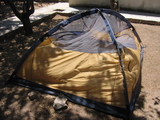 a0476 14Jul05
 |
 c3727 14Jul05
 |
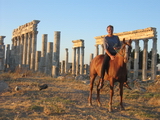 c3765 14Jul05
 |
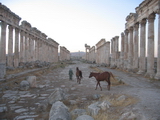 c3798 14Jul05
 |
 c3826 15Jul05
 |
 c3830 15Jul05
 |
 c3841 16Jul05
 |
 c3852 17Jul05
 |
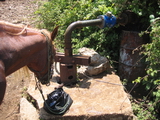 c3864 17Jul05
 |
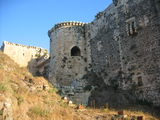 c3880 18Jul05
 |
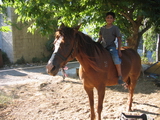 c3928 20Jul05
 |
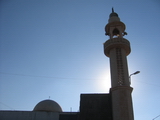 c3929 20Jul05
 |
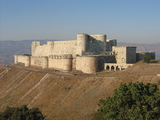 c3941 21Jul05
 |
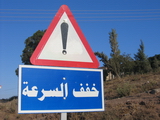 c3942 21Jul05
 |
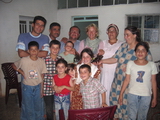 c3953 22Jul05
 |
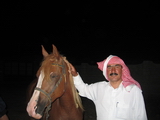 c3964 23Jul05
 |
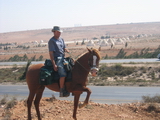 c3982 24Jul05
 |
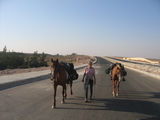 c3985 24Jul05
 |
 c4018 26Jul05
 |
 c4044 26Jul05
 |
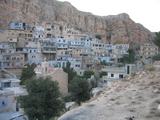 c4053 26Jul05
 |
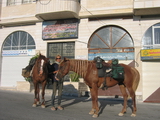 c4057 27Jul05
 |
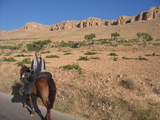 c4060 27Jul05
 |
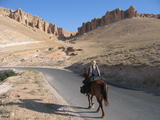 c4064 27Jul05
 |
 c4096 29Jul05
 |
 c4103 29Jul05
 |
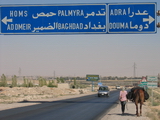 c4121 31Jul05
 |
 c4147 1Aug05
 |
 c4195 4Aug05
 |
5th
August to 6th September – Jordan – Red Sea Equestrians
‘Welcome
to the Hashemite Kingdom of Jordan’ said the sign, the one just after the
giant, smiling King Abdullah. You
have to feel sorry for Sealeah Myranda. Through
much diligent research she’s become a bona fide expert on the grasses of
Europe and the Middle East. In
Syria she’d learned that the Arabic word for grass – even though there
wasn’t any - is ‘hashish’, so perhaps it’s understandable that when she
saw the welcome sign she misread it as ‘Hashishemite Kingdom’; her ears
pricked up, her pace quickened, her hopes soared.
But from the top of the ridge, looking far to the south, these youthful
hopes were dashed: there wasn’t a blade of green to be seen, just the same old
yellows and browns as Syria.
It
was while she was still trying to come to terms with this bitter disappointment
that a man in uniform with a machine gun started touching her up, poking her
legs and pointing to various bits of her anatomy.
“Arabi aseel (purebred Arab),” he proudly informed us, “this horse
is arabi aseel!” As dumb tourists
from a faraway land, there’s no way we could have known this.
We thanked him for his advice, made our excuses and left.
There’s something about people who work at border posts.
About
a week later, somewhere in the maze of hills and valleys west of Amman, Lisa was
struck by a sudden realisation: “Do you know, I think this is the first
day in Jordan that we haven’t been stoned.”
And this had nothing to with grass. Very occasionally in Turkey or Syria the odd child had
decided to try and impress his mates by lobbing a small rock in our direction.
But here we’d had trouble everyday and it was more malicious, sometimes
just one boy on his own rushing out from a house, finding a stone and lobbing it
at the horses.
Unfortunately
the regular stonings were just one of a number of elements that combined to
leave us with a poor first impression of Jordan.
On a blistering hot day we were twice refused water for the horses; a
roadside fruit seller tried to charge me ten times the going rate for a kilo of
apples; finding places to stop for a night became a struggle again.
We were surprised because a trip to the south of Jordan a decade ago had
left us with only fond memories of the hospitality.
To
be fair, it was extremely bad luck for Jordan to have to follow Syria; we must
have become spoiled. In Syria, how
could we worry about somewhere to stay when all day people would beg us to come
to ‘al beit (the house)’? In
Syria, people just offered us everything they thought we might need: food,
water, a wash for us, a wash for our clothes.
In Syria, our biggest problem was persuading our hosts that they’d done
more than enough for us, that we actually wanted to sleep out by the horses
rather than on a comfortable mattress in the house. Yes,
come to think of it, Syria had well and truly spoiled us.
If we’d come straight to Jordan from Britain, we’d probably be raving
about the friendly greetings, the gifts of grapes and apples, the constant
interest in our journey.
At
Jarash, known for its well preserved Roman city, we were looking for a base to
rest for a few days. We found it
but then had to go searching for horse food.
I set off in a taxi and kept being directed to “the Gazza Camp, many
horses there in the Gazza Camp”. I
couldn’t understand why the famous Geordie footballer had chosen Jarash for a
summer coaching camp and, even more perplexing, what was he doing with the
horses? When I got there, all was
revealed. It was, in fact, the
‘Gaza Camp’, home to thousands of 1967 Palestinian refugees.
At another camp across town the refugees have been there since 1948 and
have only recently been allowed to put a second floor on their houses.
The taxi driver told me of a six year old boy here who’d told him
“this isn’t my home,” then pointed to a key hanging on the wall,
“that’s the key to my real home, in Gaza.”
Moving
on from Jarash, we decided to give Amman and its traffic a wide berth. I’d had enough of roads and even Lisa must have had the
highway blues, you can tell by the way she smiles.
So we risked a direct, cross-country route and were immediately punished
for our impudence.
The
river (Nahr az-zarqa) looked innocent enough on our free (and contour-free)
tourist map but the reality was what we had to ride across and the reality was a
river at the bottom of a deep gorge. As
often happens, blind faith and optimism got the better of common sense so,
instead of backtracking and taking the long way round, we plunged headlong into
the gorge. But everything that
looked possible from above proved impossible when we came up close.
In the blazing heat of the afternoon we sweated up and down the steep
rocky hillside, searching for a safe way down between cliffs.
Tired and thirsty – and helped by some bemused looking goat boys - we
eventually found one as darkness fell, only to find that the river was black and
stinking, nothing but raw sewage. Where
are the water engineers when you need them?
We had no choice but to carry on upstream to the King Talal dam where the
water was at least clean and we could bivouac.
We had nothing but a bag of straw for the horses. After twelve hours of
effort, we’d ended up thirteen kilometres from where we’d started that
morning. Here endeth the first hard lesson on the terrain of Jordan.
Another
day, another wadi (valley). But
this time we had it easy because we were following it down, not trying to cross
it. Wadi Shu-ayb took us down, a
long way down, past the ‘Sea Level’ marker and down into the forty degree
heat and forty million flies of the Jordan Valley, just north of the Dead Sea.
We spent the night at an altitude of -220m, a low point to be sure,
looking across to the west bank and the lights of Jerusalem and Ramallah.
Next
day we climbed all the way back up again, a 1000m haul up to the plateau at
Madaba. Our route took us via Mount
Nebo where, very shortly before cashing in his chips, Moses looked down and saw
‘the promised land’. We
strained our eyes but couldn’t see it. Maybe
it was the heat haze. Where was the
Mynnydd Ddu? Where was Trichrug?
Carreg Cennen on its limestone crag, normally distinctive, was nowhere to be
seen. Where were the grazed-smooth
tops of the Myddfai? Where was the
lovely Sawdde and its wooded valley? Where
were the green fields, the oak trees, the thick hedges?
If Moses had only carried on another 5,528 miles, taken the A4069
Llangadog road south from Brynaman and pulled in at the carpark - the one with
the ice cream van - then he would have a really tidy view of it.
From
Mount Nebo we more or less followed Moses’ route in reverse, all the way to
the Red Sea. Someone had advised us
not to go this way (The King’s Highway) because it was too long and too much
up and down. “The Desert Highway
is much quicker,” he said “or the Dead Sea Highway.”
But traveling by horse helps you to realise why one route has been used
for thousands of years and the others haven’t: there’s water, there’s
fodder and it’s cooler high up on the plateau.
Hannah and Sealeah were coping remarkably well with the August heat but
you can’t go far on a horse without food or water, they just don’t like it.
Our
adviser had been spot on, however, about the up and downiness.
Or rather the down and uppiness, because the plateau is cut by a series
of big wadis that you have to descend first before slogging back up.
Our route ran north to south but all the wadis, most inconveniently,
drained east to west, between the desert and the Dead Sea.
The most dramatic of these, the ‘Grand Canyon of Jordan’, is Wadi
Mujib and very impressive it is too. We
reached its northern edge at sunset to see the walls of the gorge bathed in
magic-hour light. Mesmerised by the
beauty, we just kept going down. The
canyon is 4km across and 1km deep but the road takes 25km to hairpin its way
from one rim to the other. Perhaps
it shouldn’t have come as a great surprise to find that the lovely evening
light rapidly turned into no light at all, before we were even half way down.
The only water was at the bottom; it was another long day.
After
this extra effort from our chestnut companions we gave them an easy time next
day, stopping at the Trajan Rest House which is perched on the southern rim.
In the afternoon we watched big birds of prey circling on the thermals
and gliding effortlessly across the gorge.
At night an extra large moon rose and filled the whole canyon to the brim
with silver, an unforgettable sight.
Most
nights along the King’s Highway we camped on stubble and asked for straw and
water from Bedouin families nearby. Their
tents were everywhere, some made of goat hair, others of hessian or plastic
sacks stitched together. Their
sheep, goats and donkeys grazed the stubble down to the dust.
There were almost as many children as there were goats and believe me,
there were lots of goats. Our
own child-free status was met with utter astonishment and incomprehension:
“Why?” “What’s wrong?” “Can’t the doctor help?” We tried to explain, but a camel would have an easier time
passing through the eye of a rich man (or something). Far better to just say “Ma sha’Allah (God’s will be
done)” and cast a glance skywards. The
Bedouin are, of course, extraordinarily hospitable: their endless glasses of
sweet black tea kept our energy levels high and Sealeah’s looks always caught
their eye (sorry Hannah, you’re only a ‘half’ remember).
To
understand why the Bedouin like to live out in the peace of the desert you just
need to go through a town. The
noise is enough to get your head pounding.
Tafila was similar in many ways to other Jordanian towns we’d been
forced to enter. Outside a shop on
the left are Mr Shouty and Mr Shoutier, shouting about something that might
possibly be important but probably isn’t.
In front of a café on the right Mr Shoutlouder and Mr
Evenshoutierstill are doing the same only with more feeling.
When we pass, the shouting becomes friendly and is directed at us:
“HELLOOO! WELCOME IN JORDAN! HOW ARE YOOOOOOU!”
[It
should be noted at this stage that nearly everyone we meet wants to try out
their English on us. For one young
man in Tafila this appeared to be limited to a single word.
He approached Sealeah and me and tried it out: “horse?” he asked.
The sarcastic devil inside was tempted to say “no mate, it’s a
duck-billed platypus, I’m just taking her for a walk”. But
luckily good defeated evil so I just nodded and smiled, remembering how bad and
limited my Arabic must sound.]
Behind
us trails the usual posse of screaming, singing, shouting boys.
One of them picks up a stone and…. “Who threw that?
Come on, own up, who threw it? Nobody,
I repeat, nobody is to throw any stones until I say so!”
My almost faultless John Cleese impression is wasted on them; is Life of
Brian not yet available on DVD with Arabic subtitles?
I must have a word with King Abdullah about that, see if he can pull a
few strings. At the same time,
every single scooter, moped, motorbike, car, pickup, jeep, minivan, van,
microbus, minibus, bus, lorry and wagon beeps its horn as many times as it
possibly can in the short period of time available to it as it passes us.
The drivers smile and wave; the horses jump an extra three feet in the
air with the shock of an even louder multi-tonal musical horn than the ones
they’ve already become used to. The
really huge wagons like to blast a deafening hiss from their air brakes so they
can slow down and thereby acquire more horn beeping time while they overtake us.
Yes,
Tafila was a noisy experience. After
stocking up with barley, again requiring a deviation into the charming back streets
of the Palestinian quarter, we somehow managed to pick up a three
vehicle, eight man police escort. They
kept overtaking us and then pulling in, forcing us to pull out into the traffic
to get past again. We took
advantage of the darkness on the e-e-e-e-edge of town and lost them by escaping
down a side road. We’d found a
stubble patch for the night, made a pen, pitched the tent, bought some straw, carried
some water and explained the concept of Wales to the neighbours before
the police finally found us and kicked up a fuss.
They only wanted to protect us from bad peoples, they said.
In the end things calmed down and we were allowed to stay, providing we
agreed to another police escort the next day.
We did, knowing well that they’d very soon get bored of driving at 5
kilometres per hour and leave us alone.
With the police gone, we were just starting to think that some peace
might finally descend when...BANG! A
wedding party had begun at a house over the road: two hours of fireworks and
machine gun fire!
Another
day along the King’s road took us to Dana, one of very few remaining stone
villages in Jordan – what a pleasant change from the flat-roof concrete box
with sticky up steel bars design seen everywhere else.
The village is tucked below the rim of the plateau with stunning views
down Wadi Dana - a protected nature reserve - to Wadi Araba, the big valley
running from Seas Red to Dead. We
stayed for three days in the height of luxury (i.e. showers, real food etc) at
the Dana Hotel with our tent pitched on the flat roof overlooking Hannah and
Sealeah in the backyard. Within ten
minutes of arrival, Lisa had been asked to look at every horse in the village
and she ended up spending her rest period on various farriery and veterinary
tasks for horses that, as far as we could see, were used primarily for a five
minute canter up the road every morning.
South
of Dana the riding just got better and better.
On perfect going we cantered to Shobak and camped beneath its crusader
castle, another in the long line that have dotted our path all the way from
Turkey. My afternoon quest for
straw and barley took me to the home of a man who loved ‘Britanya’ because
he’d fought alongside the British Army in Transjordan and Palestine in 1942. He was getting on a bit now but he didn’t look quite as
worn out as his neighbour, a man with four wives and forty kids, all in one
house!
From
Shobak we dropped off the plateau again and followed tracks with fantastic views
westward, down over a sea of rocky summits and domes to the hazy expanse of Wadi
Araba, thousands of feet below. We
passed Bedouin tents with the usual herds of goats grazing what appeared to be
rocks. Now there were more camels
around too, giving Hannah further opportunities to decide whether or not she can
really trust such strange looking creatures.
At midday we reached an abandoned village which, thanks to a spring, was
a paradisiacal oasis of greenery. My
diary for the day says “Stop Press! Grass discovered in the Middle East!” It
was indeed a shock, albeit a very pleasant one, to find horse food simply
growing out of the ground. We took
an afternoon off to let Hannah and Sealeah remember what it’s like to graze,
while we dozed under a fig tree and then ate too much of its fruit.
The tranquil scene was only temporarily interrupted by a passing herd of
goats accompanied by a mad shouting goat woman with a thick red woolen jumper
folded in half twice and balanced on her head.
At
Ain Musa, the head of the valley running down to the famous Nabatean city of
Petra, we took a couple more days rest to find out as much as we could about the
route to the south. Petra had been
built and had prospered here for good reason: from here on the going for trade
caravans across the desert got tough but, for a very reasonable fee, the nice
Nabateans would make sure everything ran smoothly while you were on their patch.
Despite the occasional piece of good fortune, it had been getting
increasingly difficult to find horse food and water as we moved south. A
camel may be able to go for three days without water but try that with a horse
and they’d get quite upset. A few
days earlier Hannah had warned us about her sensitive body’s requirement for
constant fibre by having a mild colic episode; we didn’t want another.
After a lot of talking to people and scribbling on maps, I was eventually
persuaded that there’d be enough small villages and Bedouin around to attempt
an all off-road route, through the mountains and across the desert to Aqaba
about five or six days ride away.
We
needn’t have worried about water at all if Moses had been with us.
Ain Musa means Moses’ Spring and it was here that the great man struck
a rock and…whoosh…out came water. Cool!
Jesus may have been able to turn water into wine but Moses’ trick is a
lot handier when you don’t have any water in the first place.
If only the two of them had been around at the same time…no, stop,
that’s just getting greedy. Quite
a long stone’s throw – maybe a catapult projection – uphill from the site
of Moses’ aquatic miracle, we found a fine solution to our equine
accommodation problem: a cave. Now
I have often been known to rant against horses (born to run) being kept in
stables, on the grounds that a stable is like a cave and that it’s man, not
horse, who is the cave dweller. But
Hannah and Sealeah mocked this theory by being quite happy in their cave: it was
in the shade all day, the view out wasn’t bad and Lisa kept bringing armfuls
of delicious ‘burseem’ (alfalfa). They
didn’t even mind me calling them ‘The Neandarthals’ for a few days until I
got bored of that and thought up some other names.
Sadly,
our stay in Ain Musa was marred by a nasty incident.
We had been using the facilities at a nearby hotel and Lisa had been
returning from here in the dark when a man ran up behind her on the unlit track
to our cave. Frightened, Lisa
shouted at him to leave her alone and quickened her pace.
But he caught up with her and then grabbed her between the legs.
I heard Lisa’s scream and sprinted down the track.
When the man saw me he immediately turned and ran off the only way he
could, back towards the main road. Before
reaching the road he ran behind a mosque and into a clump of trees before
emerging, cool as a cucumber and walking casually up to a police post on an
island in the middle of the road. I
had been shouting at top volume as I chased the man and one of the policemen
immediately grabbed him. The
man’s tactics had clearly been to make out that he was innocent and simply
being chased down the road by a madman. His
statement to the police later confirmed this.
Under the light of the street lamp we could see that the man was tall but
young. He looked about seventeen or
eighteen but someone in the crowd said he was only fourteen. Lisa was understandably furious and had to be restrained from
punching him. A police car arrived
and they were both taken down to the station.
After making statements, the boy was put in a cell for the night and Lisa
delivered back to her cave.
The
next day was taken over completely by endless visits from the boy’s relatives
and repeated trips to the police station. It
was a revealing insight into both the local culture and the workings of their
justice system. At first light the
boy’s father came round, threw himself to the ground and kissed my feet - how
lucky was it for him that this was a rest stop and I’d only recently had a
shower? He then suggested that he bring the boy round and allow me to
beat him senseless with a stick, then we could all be friends.
Lisa, of course, was completely ignored; she didn’t even come into it
as far as they were concerned; it was almost as though the offence had been
against me.
All
day various delegations of brothers and uncles and cousins arrived.
He was just a boy, they said, he didn’t know what he was doing, we
should ask the police to let him go. “So
how would you feel,” I asked one of them, “if somebody did this to your
wife?” “I would have to kill
him” he replied, in a manner which left me in no doubt that he was deadly
serious. Other people said “our
women never go out alone, why was she alone?”
But
Lisa is no stranger to Muslim societies and is not insensitive to their
requirements. We have been
traveling in Muslim countries for six months and Lisa has worked and traveled
before in Morocco, Tunisia, Syria, Jordan and Pakistan. She
had been covered from wrist to ankle, “dressed like a man” as one of the men
put it. Admittedly she hadn’t
been wearing her headscarf – we’d used it that day to make a rucksack out of
a saddlebag – but should that mean an open invitation?
The boy in his police cell had just found out that it doesn’t.
All
Lisa wanted was for the boy to have a record with the police so that he would no
longer have the ‘first offence’ excuse and maybe this would put him off a
repeat and so protect other women. She
was concerned that if I hadn’t been within earshot things may have gone a lot
further. But the police said Lisa
either had to completely drop it, in which case the boy would have no record, or
pursue it to the stage of a hearing before ‘The Prosecutor’. Lisa was assured that at the hearing she would be able to
state that she wanted no punishment for the boy other than that of a permanent
record. The hearing was arranged
for 9pm that evening.
We
attended separately so that one of us could guard the horses, still happy in
their cave and blissfully ignorant of the whole affair.
There was a delay while the police tried to find a bible for Lisa to
swear on. Those who know Lisa will
be aware that she’s quite happy to swear without a bible being present but the
police weren’t to know this. After
a while Lisa suggested that as it was the same God we were dealing with, a Koran
would suit her just as well. They
agreed with this logic but then they couldn’t find a Koran either so we all
had to hold our hands over an imaginary book and “swear by the great God to
tell the truth.”
Lisa
had to pick the boy out of an identity parade of five.
The police had cunningly put his distinctive stripy T-shirt on one of the
other men but Lisa pointed him out straight away.
Later, when it was my turn, I was asked if I could do the same.
But they must have let the other four go home for dinner by then because
my identity parade was a parade of one, not too tricky even if it was past my
bedtime. Another crack that allowed
some light into the gloomy proceedings was the translator Captain Faras’s
ambitious, but not always successful, attempts at some of the longer English
words. He was keen to improve and
asked to be corrected when necessary.
“I
think the boy’s family is very pathetic to you” was one example.
“Errr…sympathetic?”
I volunteered
“Ah
yes, very good, sympathetic, sympathetic, very good.”
Shortly
before midnight the hearing finally came to an end. The boy was sentenced to an
initial two weeks in prison before a second trial at the magistrates court.
This seemed a bit harsh but then again the boy had both lied in his
statement and shown no sign whatsoever of remorse for his actions.
Outside the police station the boy’s family actually thanked me for not
requesting a stricter punishment. The
boy went back to his cell, I returned to our cave.
Leaving
Ain Musa the next morning we had every intention of following the sensible
high-level path that had been described to me.
But we couldn’t help thinking about Petra, the ‘rose red city half as
old as time’. To ride from Wales
and bypass Petra by a couple of kilometres?
We’d probably have regretted it until we were half as old as time
ourselves. So we changed plans,
obtained special permission from an important man with a big desk and found
ourselves riding down the Great Siq, past the stunning Al Khazneh (Treasury) and
into the heart of the ruined Nabatean city.
A beautiful Arabian city on a beautiful Arabian horse; you only live
once.
Turning
south we soon left the tourist hordes behind and followed a good trail towards
Jebel Haroun (Mount Hor in the bible) where Moses’ brother Aaron came to pop
his clogs (it seems that both brothers were keen on mountaineering).
Where the path up the mountain swung west, we continued south down a
steep side valley into Wadi Sabra. Now
Wadi Sabra has a wild feeling about it; alone in the desert and surrounded by
towering red-rock walls, we suddenly felt quite small.
We’d ridden in but could we ride out?
We’d
risked this route on the dubious basis of having a walking guidebook which
referred to ‘an ancient caravan route to the south of Sabra’.
But a reconnaissance on foot showed the only way out to the south to be a
narrow twisting rock canyon. Perhaps
the ancients used caravans of rucksack-wearing monkeys?
Or specially trained goats with mini pack saddles? Fortunately
there was a spring at Sabra and some reeds that the horses were pretending was
real food. So we decided to bivouac
and put off the hard decision until tomorrow.
Even
more fortunately, I discovered a Bedouin family just downstream – mother,
father, son, twenty goats and a donkey – all of them hiding under a single
palm tree. They cleaned out a rusty
old tin with a filthy rag and a generous gob of saliva (don’t worry, it works,
I’ve done it myself) and filled it with chai for me.
By means of a hard work combination of my bad Arabic and sketching lines
in the sand, the old man confirmed that there were no horse able routes out to
the south. Instead we would have to
go west into Wadi Abu Khusheibeh before there was any feasible way to escape.
Even this route, he said, was only just possible for donkeys and maybe
too hard for horses. What’s more, he kept shaking his head and saying that it
was “ba’id” (far). But we
know all about ‘far’ and Hannah and Sealeah’s scrambling skills have been
honed on many a mountain range. So
we decided to go for it, anything to avoid backtracking.
Next
day we found the tiny path, complete with reassuring evidence of past donkey
usage, and followed its intricate way up and out of Wadi Sabra.
Walking over sandstone domes and surrounded by wild and rugged rock
peaks, we had the uneasy feeling of being somewhere that horses shouldn’t
really be. But it was fantastic all
the same: the four of us alone in the sharp early morning light, tiny dots
moving through a big landscape.
The
old man had been right about the ‘far’.
It was a relief when we reached a good track leading down into Wadi Abu
Khusheibeh. This valley is thought
to have been one of the ancient trade routes on the way from Babylon to Egypt
via Petra. Old habits must die hard
because at the first tent we reached, a woman tried to trade a pair of her
husband’s completely worn out and damaged trousers for some of our hard cash.
I commented on their poor condition.
“But look at the state of yours! Look at that! And that! And that bit
there!” she said, pointing at the numerous patches and holes and rips in my
legwear. She did have a point but
this was coming from a woman whose five kids were grubbing around half naked in
the sand, completely trouser-free! And
how could she possibly have appreciated the emotional value of a pair of
trousers that have covered my legs since home, since Day 1, since we left the
promised land? These trousers have
survived maulings by Romanian thorn bushes and frenzied Bulgarian guard dogs.
Did she really think I was just going to abandon them in this hostile
desert? And with the finish line
now only days away?
She
clearly thought I was mad, especially considering the extortionate price I’d
just been prepared to pay her for a miserly amount of straw and barley.
By now it was mid-afternoon and we still had 25km to go to reach Bir
Hamad (Hamad’s Well), the next source of water and a place where we’d been
assured there’d be Bedouin living. From
where we were there was an asphalt road all the way but it was a long hard
uphill slog under a burning sun. Dusk
brought some relief from the heat but the road kept climbing and we climbed into
the darkness. Only moments before
the dark became pitch dark we spotted a huge water tank down below the road and
stumbled down to it. Hannah and
Sealeah drank, and drank, and then drank some more. Sealeah (aka The Bristol Dribbler) then dribbled most of it
back out over my T-shirt which, as luck would have it, needed a bit of a wash.
Then we drank and it was better than wine.
If Jesus had been around I may well have had to ask him to hold back for
a bit.
Thirsts
quenched; next problem: where the hell are all the people?
Then, out of the darkness came a light.
A tiny pool of torchlight was making its way towards us.
Attached to the torch was an arm and, not far behind that, an old man.
We were so glad to see him.
“Fi
tibin?” (is there straw) we asked, hopes raised.
“Ma
fi!” (there isn’t). Hopes
dashed.
We
couldn’t believe it. Everywhere
else, people meant animals and that meant food.
But this man only lived here to keep the well going and the tank topped
up. There were no Bedouin with
goats or donkeys. It was now pitch
dark and our onward route lay off road, it would be impossible to follow until
daybreak. For the first time ever
we had absolutely nothing to give the horses for the night.
We’d already given them the remains of our bread. And they’d just had
a strenuous pig of a 45km mountain day. How
guilty did we feel? In the brief
moment between lying down and falling asleep all we could hear were rumbling
stomachs. And all we could think
about was colic.
With
the first glimmer of morning light we were up and away, down the track. We reached a Bedouin settlement and literally begged for some
straw. “La, ma fi tibin hon ”
(no, there’s no straw here) we were told.
Lisa refused to take no for an answer and marched off to ask at some
other tents. “We’re not moving
an inch,” she said, “until those horses have had some food.”
More “ma fi”s. Finally,
one old man said he loved horses and would spare her a bit of straw from his
secret stash. Lisa returned
relieved and at last, after a terrible gap of nearly twenty hours, we were able
to get some food into the poor horses.
After
a good long refueling and watering stop we continued south on jeep tracks into a
wide open bowl of desert ringed by mountains.
On our left they formed the edge of the plateau carrying the highway, the
one we’d left behind in search of greater adventure.
On our right, the rock peaks guarded the entrance to valleys carving
their way down to Wadi Araba. But
our enjoyment of the landscape was extinguished as instantly as a room is
plunged into darkness by the flick of a light switch:
Sealeah was going into colic; the nightmare had begun.
We
reached some Bedouin tents, threw off the tack and asked for water.
It was midday, the sun was merciless and there was no shade.
The next twelve hours brought nothing but agony and torment; Sealeah grew
worse and worse.
We
put a stomach tube down to dose her with electrolytes and then left it in with a
valve attached to allow gas to escape. She
went down, got up, went down again, rolled.
Over and over again. She
couldn’t escape the pain. There
was no surgical evidence that this was a surgical colic but we wanted to get her
to a clinic where we could drip her. We
realised that we were going to need some help.
Somebody ran off to fetch a mobile.
We rang Dr Ali, the vet at the Brooke Hospital Clinic near Petra. He said there was no clinic in Jordan that could do colic
surgery, there was no point taking her anywhere in a truck, he would come out
and bring drip fluids and more drugs. Now
we had nothing to lose by giving Sealeah a good painkiller.
But the pain must have been intense because she continued to throw
herself around. Now we were really
worried; there was nothing more Lisa could do until the drip fluids arrived.
All the indicators showed rapid deterioration, we just had to get
fluids into her. The wait seemed
interminable but finally, in the fading light, we saw the dust plume from Dr
Ali’s pickup blazing across the desert; help would soon be here.
The
first drip was broken during an extra violent thrashing episode.
More painkillers. The second
attempt worked and slowly, very slowly, the drips flowed, the fluid level in the
bags went down and the fluid level in Sealeah went up.
By now it was dark and several more pickups and jeeps had arrived.
There was an army camp nearby and the men from Special Forces had come
straight over to help. Engines were
left running and all headlights turned on the patient.
I wasn’t aware until afterwards who all these people were, they were
just a background blur. But it
struck me how readily so many people had pitched in to help, doing whatever they
could and asking if they could do any more.
The hours passed and the drips flowed until nearly the full twenty litres
had gone in. Sealeah was well
hydrated but the whole time she had been getting worse.
Gut sounds were now zero, the colour of her gums was awful, and it was
only the regular inputs of painkillers that kept her from rolling in agony.
I sat in the sand and held her beautiful head in my hands.
“She’s just not improving”, said Lisa, “we’re going to have to
think about how much more pain we should let her suffer”.
She turned to Dr Ali. “Do
you have a gun?” “No, but the Bedouin here will have one, somebody will have
one.”
The
words were like knife wounds. We
were going to lose her like we’d lost Audin, but this time it was very
different, this time is was our fault.
We’d gambled and lost. We’d
wanted to go alone with no support, like we had done since Day 1.
We’d wanted an adventurous route.
Now, sitting in the desert, faced with a dying horse, faced with losing
another loyal friend, these ideals seemed ludicrous.
If we lost her, I made up my mind to just crawl off into the desert and
stop living. Lisa and Ali were
discussing another option: putting a metal tube in Sealeah’s side to release
the trapped gas that was causing all the trouble.
Ali wasn’t happy because it virtually never works, the horse still
dies. But as a last resort ?
Lisa began disinfecting a patch of skin on Sealeah’s flank and getting
some instruments ready. I was just numb. After
all we’d been through I couldn’t accept that we were going to lose her.
But
then a turning point. The last dose
of painkiller had worn off but she’d remained relatively calm.
The tiny burps of gas coming down her stomach tube became bigger and more
frequent. The last drip was
squeezed from the last drip bag and we led her off for a walk.
Earlier, Lisa had put some local anaesthetic solution into the drip bag.
This reduces gut pain and can stimulate movement of the intestines,
exactly what was needed to shift the gas. It
doesn’t always work but we were counting on it.
Suddenly, another glimmer of hope: a fart.
A small one but a fart is a fart. Better
out than in (as they say). “Sealy
farted!” Lisa shouted. The
assembled Bedouin laughed. She
farted again and it was bigger this time. “Sealy
farted!” said one of the men, very pleased with this new addition to his
English vocabulary. Now everyone
was laughing. We trotted her
around. More farts.
She went down and rolled then just lay on her side in the sand.
Everyone crowded round, anxious again.
Then it came. The biggest, longest, loudest, most utterly beautiful fart
that’s ever been farted in the long history of farting. It just went on for ever; all that horrible trapped gas was
finally escaping. “SEALY
FARTED!” shouted ten Bedouin voices in unison.
Laugh? I nearly farted.
At
three in the morning we finally lay down outside Salaama’s tent.
With Hannah and Sealeah tethered beside us, we listened to a wonderful
duet: two horses, both of them eating. With
Sealeah alive again, the million stars above us were more beautiful than ever.
Salaama
was about the most laid back, friendly, generous person you could imagine.
We needed to give Sealeah a few days to fully recover.
“Stay for a month,” he said, “no problem!”
His home was a tent of two halves: one half was for women and children,
the other was for the men and it was here that all the serious tea drinking work
was done. Like the glass and half
of milk in every Cadbury’s chocolate bar, there was a glass and a half of
sugar in every pot of Salaama’s tea. The
army boys came round for breakfast. “Sealy
good?” they asked, “Sealy farted?” Salaama
pointed to one of the soldiers. “Look,”
he said “too much moustache.” He
had a point; it was way bushier than your average ‘tache, verging on a full
handlebar in fact. In a ‘Dances
with Wolves’ kind of way, the name stuck.
Too Much Moustache had been in the thick of the action in last night’s
battle to save Sealeah and we thanked him for it.
But he still wanted to do more and so drove off in his Land Rover to get
us some bales of alfalfa. Those few
days spent living with Salaama and his family and friends were a special time,
more interesting insights into how others live their lives.
We made new friends among the Bedouin of Humeimah and were pleased to
accept their offer of delivering some hay and water by pickup to our next
planned stop at Jebel Kharazeh. From
now on we were more than happy to enjoy the final few days ride to Aqaba without
living in fear of dehydration or colic.
Through
the desert to Kharazeh and south to Shacria, the sandstone peaks grew in
density, size and beauty. Crossing
the Hejaz Railway, we entered the awe-inspiring valley of Wadi Rum.
We were now on familiar ground, having spent a couple of weeks climbing
here in 1996, but it was still amazing to be riding down the middle of this
‘vast, echoing and Godlike’ valley, as T.E.Lawrence (of Arabia) described
it.
After
a final, peaceful, simple night in the desert south of Rum, there was a long
steady climb to a col at 1000m. How
many passes had we crossed since leaving home, I wondered?
Plenty, but this was the last; it was all downhill from here. During
the First World War, when Lawrence of Arabia and Faisal’s soldiers of the Arab
Revolt rode from Wadi Rum to take Aqaba from the Ottomans, they came to a halt
when faced with their first view of the town.
“Aqaba!”
said Faisal.
“Aqaba!”
said Lawrence.
That’s
how it went in the film anyway; it was a short script.
Then they all had a good gallop into battle with lots of shouting.
In
anticipation of a similar moment – but without the messy battle afterwards –
Lisa and I had spent some time learning our lines.
But when it came to the crunch, we fluffed them.
“The
Red Sea!” said Lisa.
“The
Red Sea!” said Harry.
To
be fair to us, we couldn’t actually see Aqaba but we could see the Red Sea. The way Lawrence and Co went is now a dual carriageway
clogged up with trucks so we’d taken a more southerly route from Rum, the
shortest way to the seaside. Aqaba
was hiding behind a mountain. Away
to the left was Saudi Arabia, over on the right was Israel and across the narrow
sea was Egypt…Africa. We’d come
a fair old way. All the way down I
patted Sealeah on the neck and generally told her how great she was. She agreed with this but wondered whether there might perhaps
be some kind of edible reward to accompany this outpouring of much-deserved
praise.
In
a few hours the long descent was over. In
fact, it was all over; after five hundred and ten days and five thousand
eight hundred and seventy miles, this was it: The End.
We crossed the beach and waded into the warm, tropical water.
We couldn’t swim because there was a coral reef in the way; you don’t
get that problem down on the Gower.
We were happy but we weren’t jumping for joy; one of us was
missing. He should have been there
and he wasn’t and we missed him.
Audin.
We loved you. We miss you. We
will never forget you.
Last modified 25 Sep 2005
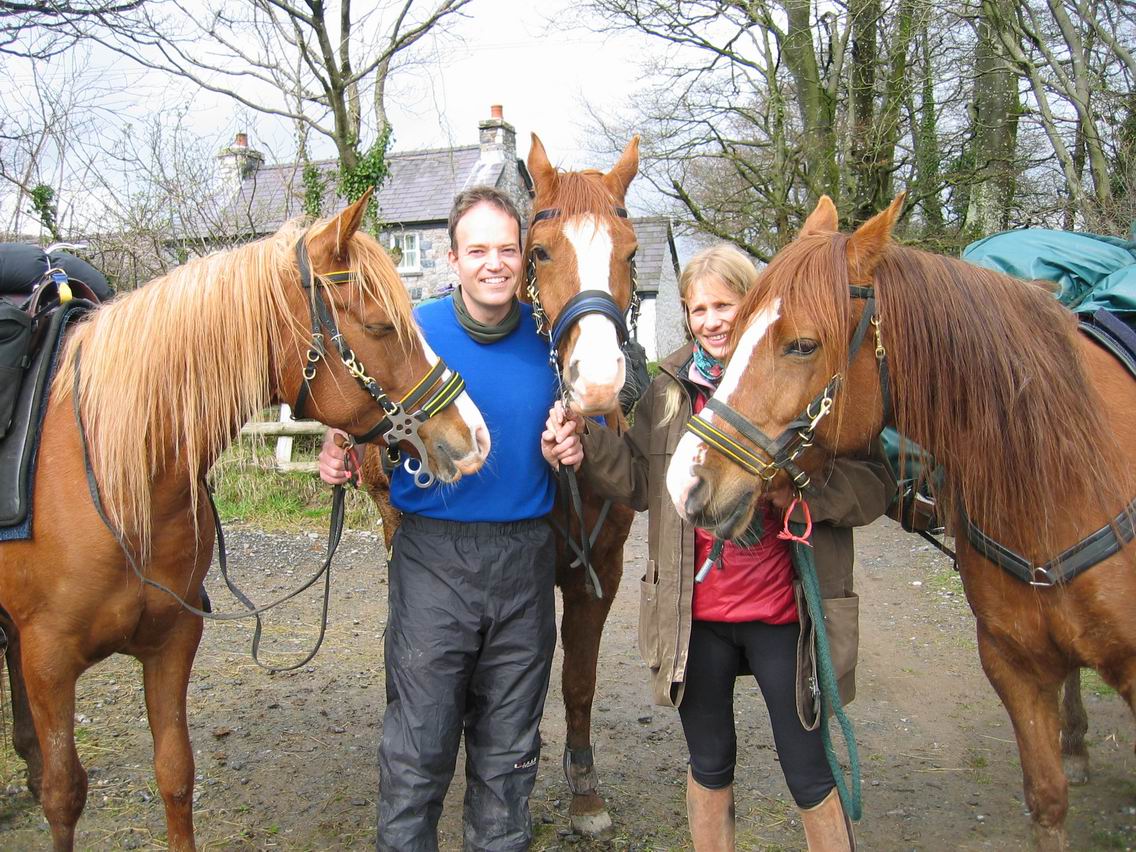 a0476 16Apr04
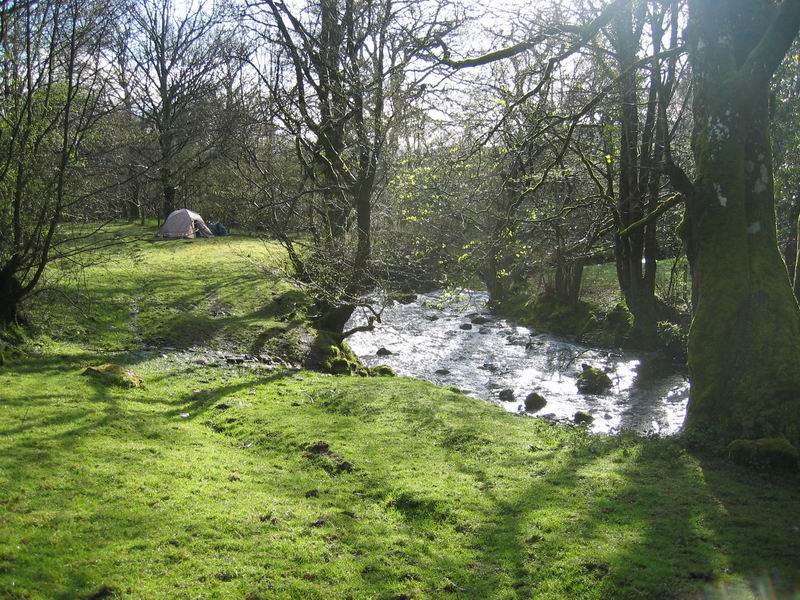 a0486 18Apr04
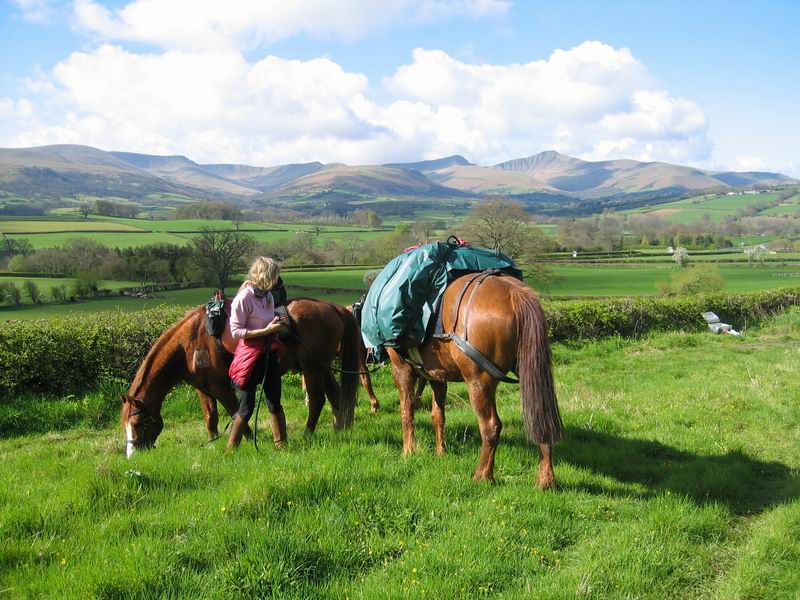 a0493 19Apr04
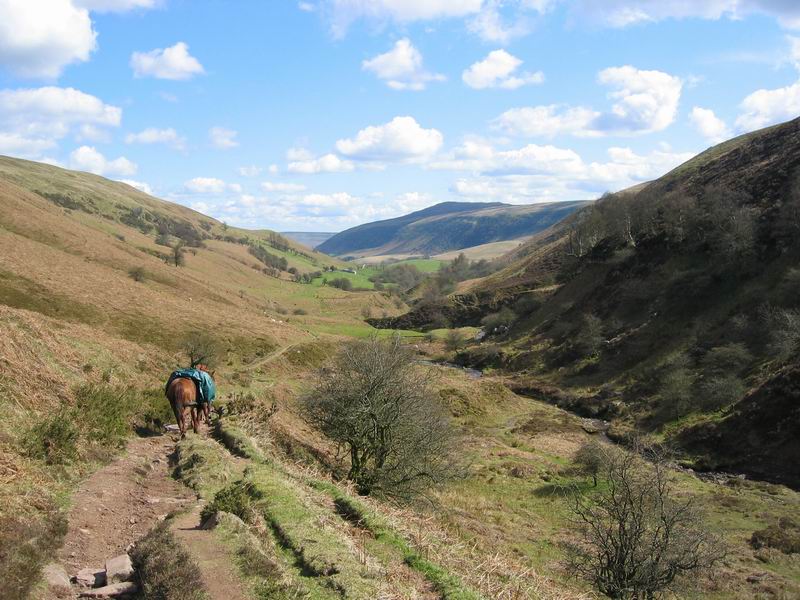 a0506 19Apr04
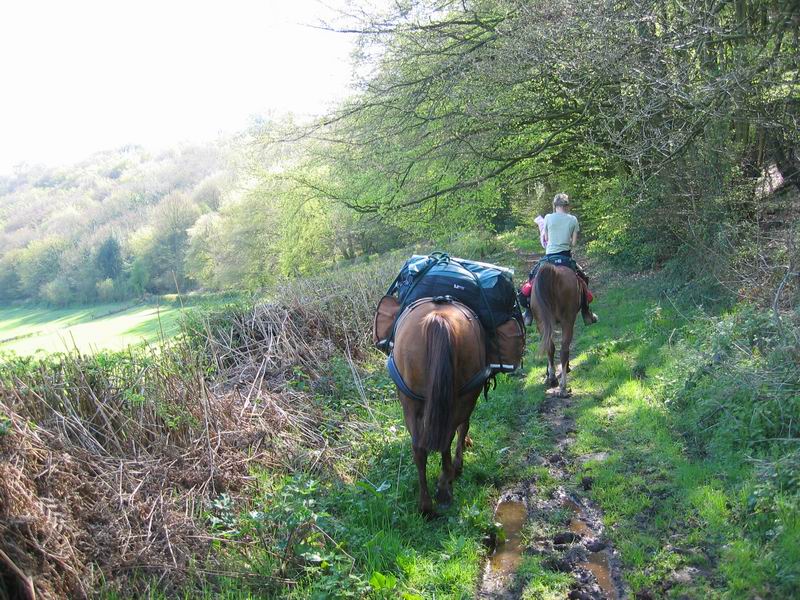 a0519 24Apr04
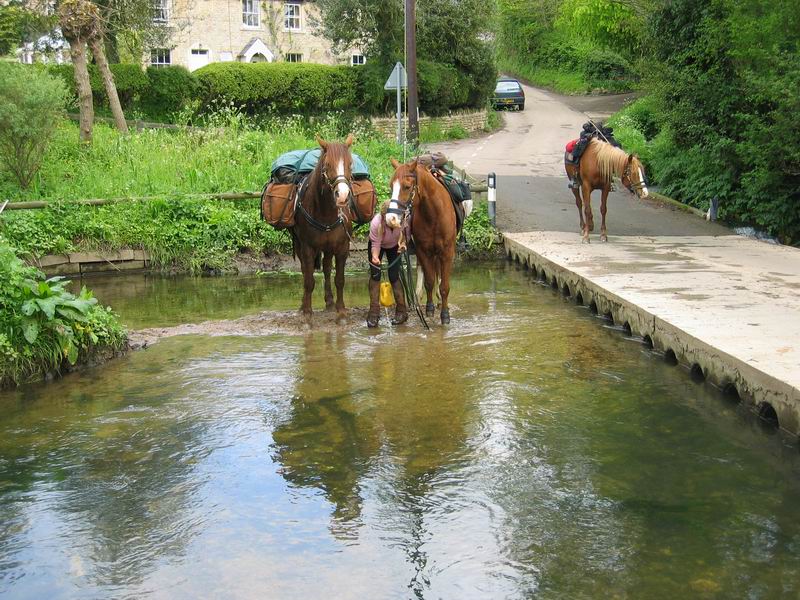 a0553 2May04
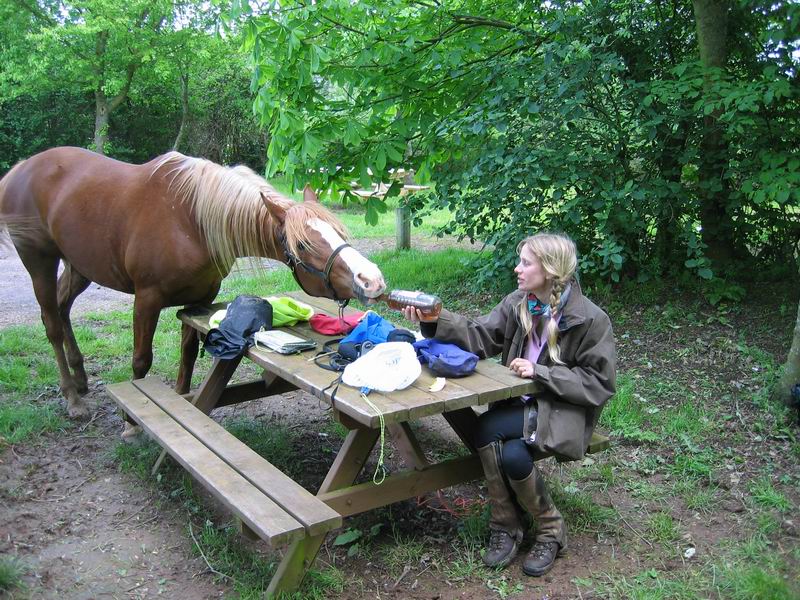 a0599 6May04
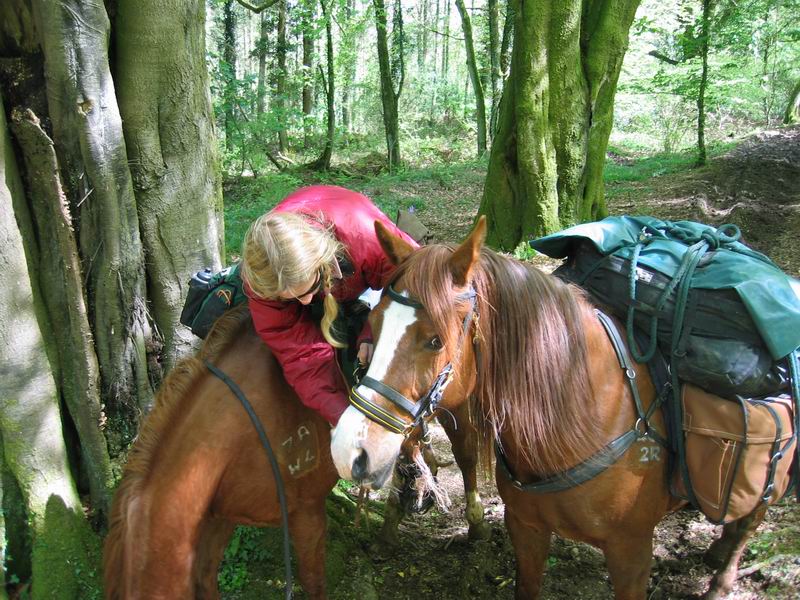 a0616 7May04
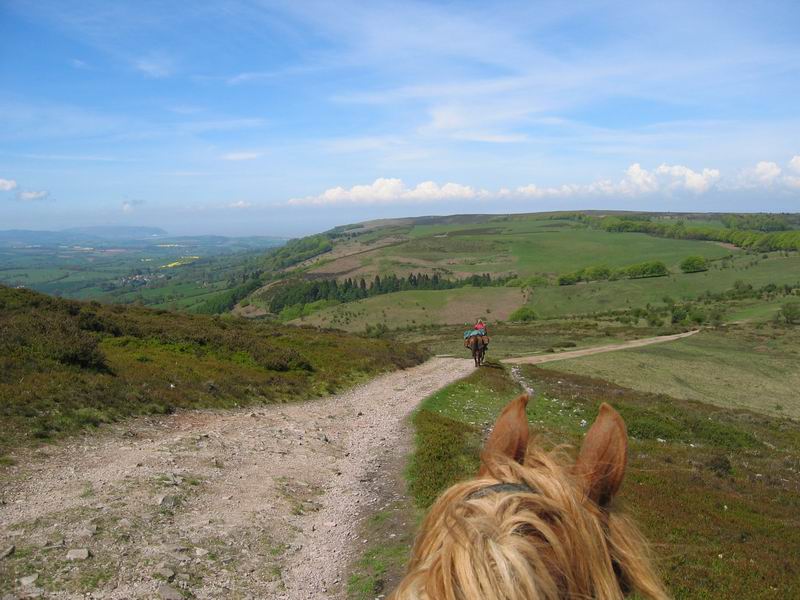 a0635 7May04
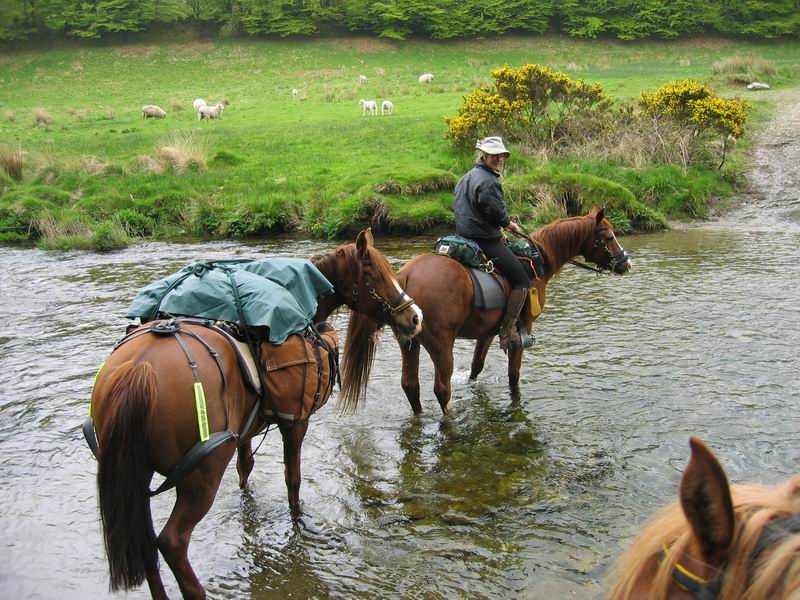 a0704 12May04
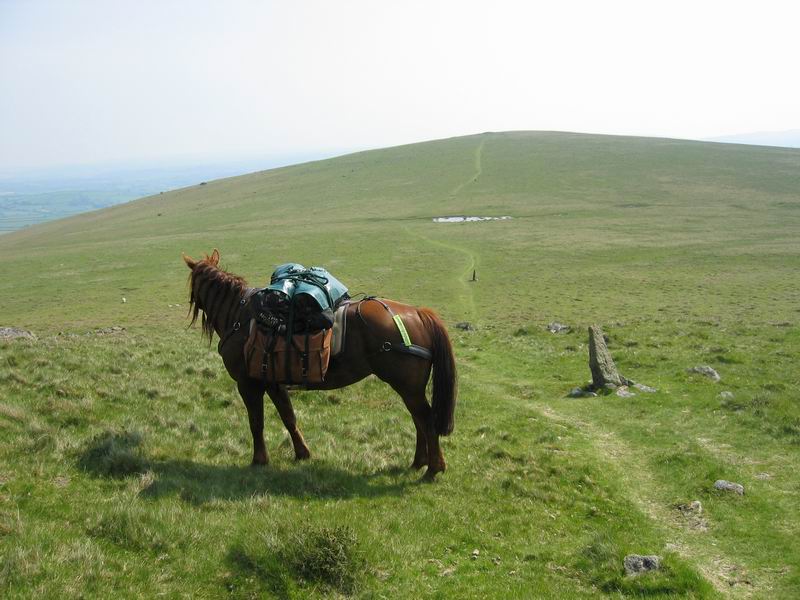 a0789 17May04